Showing posts with label Observations. Show all posts

Monday, September 15, 2014

To Apple Watch or Not To Apple Watch

Apple Watch Sport Collection
Photo Courtesy of Apple
Before I get into this, I need to disclose that I am a huge Apple fan.  Not quite a fan boy, but not not a fan boy. And for those posts where people say I was compensated to share this or the product was provided for free - that's not the case here. It's kind of the way around.  Apple was compensated by me. Several times over. A lot. And then some more. Yeah, I have lots of Apple stuff. And I like it.

OK, that said, I'm torn about the Apple Watch. It's very cool and all that. No doubt. It does some really neat things. For sure. It's gorgeously designed. As with all Apple gear. Will I buy it? Not so sure.

I expected to see the thing and be like, "When can I preorder?" But I didn't feel that way.  I may still get one, but I'm not rushing into it, and wouldn't get it because of a clear need or use case (kind of how I felt about the iPad).  The reason for me is that the fitness tracking part of it doesn't really work for my needs.

Nike FuelBand SE
I have a Nike+ FuelBand (that I'm planning to stop wearing at the end of the month since I don't find it impacting my behavior anymore, and can't stand Nike's website given the molasses-based speed and constant issues/downtime). It tracks steps, calories, general activity, and provides awards and motivation, just like Apple intends to do with the Apple Watch. Nike has really stepped back from how involved and invested they were in the Nike+ ecosystem, with less investment in the ramification side. You used to get these little videos with a character called Fuelie, but they stopped doing that. Now they have all these random trophies that I don't fully understand the point of and seem to win far too easily (I win more than 1 a day, and don't know the difference between them, nor do I care). Their site is also painfully slow, down far too often for maintenance (that doesn't seem to be for any benefit in functionality), and parts of it just don't work (you have to tell the SE version of the FuelBand when you're in some sort of workout session and then go tag that session with the proper activity on their site, only the tagging page stopped loading about two weeks ago, and still isn't working. I can tag things from the iOS app, but it means syncing via USB (Bluetooth syncing stopped working on my FuelBand for some reason), and then going to the phone to tag).  I would rather an activity tracker be smart enough to know that I'm being active, and not need me to tell it as much.  Apple seems to have done this better as they claim the Watch knows if you're biking versus running.  But this will be something to watch for and judge after its released since it's all a bit unclear and untested now.

Garmin Forerunner 620
I have a fantastic running watch (Garmin Forerunner 620). I don't usually run with my phone, or at least I prefer not to. I won't hold it due to the impact on gait, and don't want to bring a bag or pouch just for my phone. I find arm bands uncomfortable, and I sweat a lot, so my phone invariably ends up wet - that can't be good for it in the long term.  But I need that GPS tracking that the Apple Watch can't do without a phone.  I'm a total data junky, and want everything recorded.  Without my phone, the Apple Watch can't track my run beyond simple step measurement.  I need pacing, and it can't really give me that.  I also get some awesome advanced metrics from my Garmin as I pair it with their FirstBeat-enabled heart strap, so I get cadence, ground contact time, vertical oscillation, training effect and VO2 Max data.  The Apple Watch can't do any of that (with or without a phone), and I have come to appreciate it.

There's talk about why Apple didn't put GPS in the Watch. It's likely due to price and package size for something that isn't a common need (even if you cycle or run daily outdoors  as I usually do but the majority of people likely don't (or do it in a gym on some machine), you still don't need it a lot of the time of the day). And GPS does drain batteries, but running watches don't keep it on unless you're in a run. And then you can just charge it when you get home - that's what I do, and I don't get mad at the watch or decry its battery life since I knowingly did something that is a power hog.

I think size, cost and battery considerations are part of the story, but I think it's also about making the phone more valuable to watch buyers and vice versa. Remember, the Apple Watch only works with the iPhone (and only models since the 5). Smart business decision, despite any annoyance it may cause. I'm just saying that including a GPS receiver in the Watch could actually fuel more sales for people like me.

So, would I buy a smart watch to take it off and wear a different smart watch for runs? That's the question. For me, I don't think I can answer that until the device is out, more of the features are known, and I think about what is missing that I'd really want before buying it. That's what happened with the iPad - I knew I needed a front facing camera to do video chats with my wife and son when I travelled for work, or it wouldn't be valuable enough for me to buy.  So I waited until they added that feature, and bought an iPad 2. For me, it could be a question of waiting for the Apple Watch 2. Or maybe the 2S. Or 2C.  Or 2 Plus. Or whatever. We'll just have to see.

Friday, April 11, 2014

Laterz Haters


For those who don't follow me on Twitter, Facebook, Google+Strava, Garmin Connect, DailyMile, MapMyFitness, Nike+, YouTube, Instagram, TrainerRoad, etc...wait, what was I saying? I lost track after building that list.  Oh, right, for those who don't follow me, I've been doing a month-long bike training program on my Wahoo KICKR through an amazing app called TrainerRoad.  The program is called The Sufferfest Build, and it's based on the insane training rides put together by Singapore-based The Sufferfest. They take footage and experience (incline, competitiveness) from actual races, superimpose intervals and technique training, and basically kick your butt.  The Sufferfest Build program TrainerRoad put together has six days of riding a week (you take Monday off), with alternating between intense rides and recovery/endurance rides, plus two long rides on the weekend (one very intense, one moderate but long) - see a map of the plan below.  I'm on week two, and already see the difference in my ability.  To call it tough is an understatement.  To call it fun and energizing is also an understatement.
A map of the plan. It is intense stuff mixed with recovery time, and a ton of fun. Image courtesy of TrainerRoad


So, when I finish my rides, I post them up to my various social media channels, including the fitness networks I'm part of. I also often will mention others, like the equipment makers for the stuff I'm using if I love it or have a particular comment about it. I've been posting about my Sufferfest Build experience on Twitter with mention of @WahooFitness, @TrainerRoad, and @TheSufferfest. The problem with that last one is that I was forgetting to include the 'the'. So, turns out, there's some other Twitter user who was getting notified of my activity.  Not only that, but they weren't too impressed, and felt the need to share that with me - see what they wrote:


The workout they were writing about was a recovery ride, so my performance was nothing to write home about (though obviously I felt it was something to write all my followers about - but, hey, that's just what I do, and I suggest you do it, too). I had done 35 minutes of intervals on the elliptical that morning, and then did my first run of more than one mile in months (and likely my last for a few more months as my foot is still not ok) literally right before hopping on the trainer for 60 minutes of low intensity form practice (for those who know what this means, the FTP was about 50% of my current level, and I used the TrainerRoad Pettit course, as per the Build's plan).  So the effort, achievement (kJ, TSS, mileage, etc) was not great, nor should it have been.  My ride today will be mega, by the way.

So, yeah, if that meant to be a race performance, I should possibly go pickup another sport, but it wasn't meant to be anything but some time on my bike and trainer.

But let's analyze this for a moment.  By 'this', I mean the idea that I should change sports if I am not performing at elite levels. If I was making my living competing on my bike, sure. But I'm not. I'm keeping fit and enjoying the process on my bike. Why would I get off?  When I run races, I do ok, but I'm not a rock star and don't really stand to be a top finisher in the races I sign up for. Would I mind? Not at all - I'd be elated. Do I care? Not really - I'm not bothered by it at all. So why do I do it?  Why do so many people do these things if they won't win?

You see, the issue is all one of semantics. 'Win' doesn't have to mean coming in first. 'Win' can mean so much more, but it's defined only by the person doing the activity in question. No one else.

Elon Musk, founder of PayPal, Tesla and SpaceX, has this great quote in a 60 minutes piece done on him. He talked about how there was this high chance of failure with Tesla, and he didn't expect for it to succeed.  The interviewer why he'd try if he never thought they'd make it. Musk said the greatest things may not be the ones that succeed, but that doesn't mean you shouldn't try. He's speaking about achieving greatness and doing things for the overall betterment of the world (your world or the world more broadly). The point being, don't let the fear of failure stop you from going for it. And by extension, don't let someone else's definition of success deter you from trying.  Here's a quote of the conversation:
Elon Musk: Well, I didn't really think Tesla would be successful. I thought we would most likely fail. But I thought that we at least could address the false perception that people have that an electric car had to be ugly and slow and boring like a golf cart.
Scott Pelley: But you say you didn't expect the company to be successful? Then why try?
Elon Musk: If something's important enough you should try. Even if you -- the probable outcome is failure.
So, the message here is simple. Don't let someone else with their definition of the word 'win' influence you, your definition, or what you do. Chose what a win is to you - and that can be as simple as showing up for the race/finishing at all/getting on that bike 3 days this week/etc. Push yourself to win as you define winning, and as you do it, raise the bar for yourself to keep winning overall.  As I say in one of our podcast episodes, win your way to success, and enlighten.your.body.

Wednesday, January 22, 2014

Lessons from my 1st Interview

So I recently got to interview a very inspirational guy, Dai Manuel, for my podcast and YouTube channel. It was a great experience with some really awesome discussion - no surprise given my subject.  In addition to all the great content, I learned a ton since this was my first web-based interview, so I thought I'd share what I've learned.

the setup
I used Skype to do the interview, and a piece of software called "Call Recorder for Skype" from ecamm Networks that lets me record the video chat and split the two halves into their own movie files. It's a very cool feature.  This allowed me to let each side of the conversation be focused on, rather than having the screen split. It also allowed me to be off camera while Dai was talking so I didn't have to worry about how I looked.  I don't mean whether I looked good or not, but if I had to move out of the shot for some logistical reason or something like that. It just allows the viewer to focus on the speaker more than a distracting side image.

I used a 13" Retina MacBook Pro with a Core i7 processor, 16GB of RAM and 1TB SSD, and for audio, I used the built in mic and speakers.  I was connected over WiFi, but would have preferred a hard wire. I had also run an extension chord and power strip to be sure I wasn't on battery power.  Stupidly, I turned the power strip off about 10 minutes before the call without thinking as I'm big on saving electricity.  That strip also powers my treadmill, but was off, so I figured, "Hey, let's save the planet." It's a habit. See how it may have mattered in the quality section.

Dai was on his iPhone, and had the Apple headset plugged in for his audio.

I also had my Canon Vixia camera running on the side, focused on the screen as a backup just in case.

quality
Having shut off the power to my laptop, the processing power was throttled back. This ended up mattering in how well the recording was keeping up with the video chat (mainly the frame rate). If you watch the video, you'll see some periods where there's jagged movement.  The call also dropped twice, which could have been my WiFi, the load on my computer from doing an HD recording.

Audio was interesting. Dai's voice was very loud because he was using a headset, while mine was pretty soft.  I had to adjust the audio tracks for both of us to compensate for this. Also, because I was using my built in speakers and mic, my audio track included a low-fidelity capture of Dai's voice (what my mic picked up through my speakers). As much as I don't want to use a headset, I will think about it strongly next time to avoid this. It wasn't a huge problem overall, but there are moments where we're talking simultaneously, or where the way I've edited things makes it awkward (he says something, then I pull my video/audio in to ask the next question, and you hear the end of something you just heard him saying).  An alternative would be to use a dedicated mic, and shield it a bit so it picks up less audio from my computer.

I do think the audio from the headset - while certainly loud enough - was not as clear as I'd like. It could just be the Skype connection, but I'm guessing it was also the headset itself. It's an OK mic, but not amazing.

running the show
I didn't establish rules for the interview. That is, I didn't act as a director. Dai had a lot of great things to share, and I didn't want to cut him off. I had sent him the questions just before the interview, so he was naturally covering the material I was hoping to get into.  I didn't realize it at the time, but this lead to really long cuts of Dai talking, and less of an interview.  I'm overall fine with this as I think the material is great, but it taught me a lesson for next time in case the material isn't flowing as well or the interview is going way off topic - I should have established a gesture or something to insert myself so I could keep the interview to my intended topics and questions.

I lucked out here, and think the others I've reached out to for interviews will also be fine, but as I say many times, luck is not a strategy.

split personalities
The split video files were really cool, and I definitely liked this approach better for such a long interview (31 minutes) than having both of us sharing the screen. With the audio issue I mentioned above, I don't think it would have worked to have it all simultaneous since everything Dai said would come with the version my mic picked up layered over it. While you don't have to split the video (you get a combined file, and then have drag-and-drop filters you plop the file on to create the split versions), you have to say you want this upfront as the output file is different (it's essentially a 32:9 file made of two 16:9 images side by side versus creating a single 16:9 image that's split between an 8:9 of me and 8:9 of Dai). That means I couldn't really opt to go back to a side by side. So I was committed to it.

Luckily, ecamm built in a droplet to split out audio sides separately from video sides (you can get both together, or separately).  There are times when I wanted to clean up the audio tracks a bit, and needed them separated from the video.  These filters alone made Call Recorder worth the price (it was $29.99).

The downside to this approach is that I ended up with lots of back and forth between us. I could just cut back and forth, but it felt too choppy, so I used transitions. Every time I use a transition, I'm reminded of a Simpsons episode where Homer makes a dating video of Ned Flanders using a kid's video editing board Lisa has.  He uses a star-wipe effect between each cut scene, and Lisa warns him that it's too much.  He pushes back, insisting you can never have too much star wiping.  Lisa was right, but the video is hilarious.  Anyway, that always makes me concerned I've overdone it with the jazzy transitions.  I scaled back to really simple fades most of the time as the novelty wore off and I ended up almost feeling nauseous from all the cubed-wiping and card flipping going on as Dai and I went back and forth.

editing takes time...lots of time
I spent two days editing the 31 minute final product. Part of that was time I lost because of a computer problem, but a lot of it was nitpicking trimming clips, aligning audio, and trying to get nearly 50 minutes of content down without losing the point. I honestly wouldn't have cut anything, but it was too long for most viewers. So if I was going to cut, it had to be well done and the essence of everything Dai was saying had to be intact.

in the end...
I think the content is what made the interview solid. Dai's an amazing guy, and really gave of himself in a very real way in the interview, and you can't help but be inspired coming out of it.  I was inspired myself by his words, and also by what I'd do differently next time.  In summary:

  • make sure my laptop is plugged in, and all other programs are quit
  • establish rules of engagement so I can be the director and get the interview I'm looking for
  • find a better way to capture audio on both ends (in case the next person uses a setup like I had), or ensure we don't talk over each other
  • make sure I have solid editing time blocked out
  • make sure your interviewee is willing to help promote the video and earn the right to check in to make sure they do


I had a great time doing the interview, and really enjoyed watching the finished product with my wife. Creating inspiring content for others is another way to enlighten.your.body.

Sunday, January 19, 2014

Podcast Episode 009 - enlighten.interview: Dai Manuel

The first interview from newbodi.es, we are honored to bring you the inspirational and motivational Dai Manuel, COO of Fitness Town and one of the top health and fitness bloggers in the world. Dai has a similar story to mine with a background as an overweight teen, then changing his life and working to change the lives of others.


If you enjoyed this video, subscribe on YouTube or get the podcast on iTunes and spread the word. It's one more tool I'm giving you to help you enlighten.your.body.

Wednesday, January 1, 2014

Eat Your Kids Scraps - Just Make Them The Right Scraps

You hear a lot from parents of toddlers about how they put on a bunch of weight eating their kids leftovers. Parents, you know the drill, you give your kids chicken nuggets, mac and cheese, peanut butter and jelly, etc, they eat some of it (hopefully enough to fuel their little bodies), and then have scraps to throw out. Invariably, you eat the scraps rather than tossing them.

I was guilty of this.  It adds pounds to parents, for sure.

So I cut that out. It helped.

But I realized that I've been eating my son's scraps again. And it's not resulting in weight gain. Why? The issue wasn't the scraps. It's what the scraps were made of. You have to get to the root cause of the issue. If you are feeding your kids processed foods, eating those scraps will be other than good for you, to put it nicely. But why not realize that these foods aren't good for them, either?

Last night, I had peas, carrots and chicken from my son's plate. They were all tasty and totally good for me. More importantly, they were good for him.

So, yeah, cutting out scraps of not-great-for-you food is a good idea, but cutting the not-great-for-your-kids food in the first place is the best idea. Set the right example and provide the right things for their growing, little bodies. To start, enlighten.your.body,

2013 By The Numbers

As 2013 closes up, I took a look at my tracker spreadsheet (get yours here) that I use as part of the first of my 10 principles, which is "track it" (see the video on our YouTube channel).  What I saw was pretty interesting in the last column, which sums up each row of the table - be it an exercise or some body stat.  I thought I'd share a few of the stats - keep in mind, I didn't do all of these things every day (for instance, I only started cycling in July, and stopped in November), and not everything I did got tracked:

  • 4,878 pull ups
  • 19,360 push ups
  • 12,859 squats
  • 9,649 minutes of elliptical, covering 802.9 miles and burning 142,536 calories
  • 4,991 minutes of running, covering 451.3 miles and burning 63,530 calories
  • 7,201 minutes of biking, covering 2,031.7 miles and burning 98,289 calories
In total, I recorded 22,293 minutes of cardio, covering 3,413 miles and burning 308,994 calories.

On the body side, my average weight was 177.5 pounds, with an average body fat of 10%.  I got as low as 5.2%, but after my half marathon and the time I've had to take off from hard training due to my tendon issue in my foot, it's crept up over 10% as I ended the year.  I'm at 12.2% and 186.2 pounds at the moment, and plan to have both of those numbers back to where I want them before January is over - 180 and 10%, respectively.

Since I had a few injuries in 2013, and started the year recovering from knee surgery, I'm excited to see how 2014 shapes up.

How was your 2013? If you were tracking it, follow principle 2 and go public by sharing how you did with others. How are you going to do for 2014? How will you enlighten.your.body?


Friday, December 27, 2013

2013 - A good, fast year

I thought the timing was right to do a little reminiscing on 2013. This was a big year for me after 2012, which started great, but quickly was defined by two injuries and two related surgeries.

2013 was a year of several firsts

It was also a year of PRs
  • Fasted 5K
  • Longest run
  • Longest ride
  • Most miles run in a week and month
  • Most consistent runs
As in most years past, I also had several unfortunate side-linings just when I was starting to really hit my stride (literally and figuratively). I'm currently off from running due to a tendon issue in my left foot that started in September as I ramped up my mileage for my half marathon, but I also dealt with Achilles pain, quad strains, knee pain, etc, etc, etc.  The thing about this year is that I generally haven't let that stop me.  Why? 2013 is also the year that I really feel my repertoire (or arsenal, depending how aggressively you want to look at it) was really well-developed and in a place where I could deal with injuries and keep going. I learned a lot in getting my certification (and the Corrective Exercise Specialist credentials I'm working on now), but I also learned a lot about and with my own body first hand, and just understand things better - like it all sort of clicked.  I've been a regular at my physical therapist's office and have learned a lot there, but I view that as completely beneficial rather than something I have to do because of an injury.

A big reason why the physical has all fell into place despite injuries along the way is that 2013 was a big year for the mental side of my development. I've always stressed how you must bring your mind along with your body for health to truly take hold and stick in your life. I've read some fantastic books (probably the most impactful being "Choose to be Happy" by Wayne Froggat). I also made a point of reading some enjoyable books (Scott Jurek's "Eat & Run" was a favorite), and some that crossed both (Jay Dicchary's "Anatomy for Runners" is an absolute must read).

I've had lots of personal wins and personal losses, professional wins and losses, and physical wins and losses. As do we all. The balance is in the right place, and I found myself having an active hand in creating that balance by investing in myself. That's what I mean by enlighten.your.body. It's an active thing you do for yourself. It doesn't happen to you (or I'd have said, "get.your.body.enlightened" or something passive like that).

Look back on your 2013. How'd you do? What will you shift in 2014 to bring the right balance to your world?  How will you take an active stance on your health, happiness and life overall to enlighten.your.body?

Wednesday, October 30, 2013

Lessons from my 4th Race (1st Half Marathon)

Yesterday, I completed my first half marathon, the Ashland Half Marathon (there's also a 5K so it's official the Ashland Half Marathon & 5K). I say first because, by definition, it was, but also because I plan to do at least another (I'm already signed up for the Runner's World Heartbreak Hill Half in June - join our team by selecting "newbodies" if you're doing it!). It was a pretty emotional lead up as I've been battling a few different injuries, and had to switch my shoe plan at the very last minute with no real testing of the shoes I was to run in. For anyone who runs in races, you know that you don't mess with your race plan last minute, and you definitely don't use something you've never used before the race. I had run in these shoes before (Adidas Adipure Gazelle), and liked them, but have had issues with them lately, so I was nervous. They also don't really have much cushioning at all, so if I had to back off from toe striking, I was putting my knees at risk of injuries from heel striking without any shock absorption.

I'm getting ahead of myself...this is my fourth lessons from a race, so be sure to read the first (actually a series of 3 posts), second and third.

Race day was a beautiful New England Autumn day in historic Ashland, MA.  The Boston Marathon used to start in Ashland, and they built a part (called Marathon Park) complete with plaques to commemorate the fact. This was where the race started and ended.  It had rained at about 5 AM, so the ground was slightly wet (another thing my shoes aren't great at dealing with).  674 attempted the Half (577 finishers), and another 454 went for the 5K (408 finishers) - all grouped together at the starting line. I was lucky to get a spot about 4 people back from the start, which made for a much better beginning than in any other race I've been in where I've had to contend with lots of people in front of me that I needed to weave my way through (I don't like running in a crowd, so I try to break out and find a good slot in the first half mile).

In addition to lots of spectators and race officials, racing legend Bill Rodgers was there.  He won Boston and NYC four times each on his way to winning 22 marathons globally. Pretty cool to see him.

I should just say, having a quality race organizer and race management company makes ALL the difference.  Hats off to the entire organizing team for the Ashland Half and to Race Menu, who managed the registration, course, timing, logistics, etc. I've done a few races that have had professional race management companies on the job, and it's night and day. The courses are the right length, the mile markers are in the right places (almost always - RaceWire and CitySports, I'm looking at you!), and results are posted quickly and correctly. I've been in two events that lacked real race management, and they ranged from ok by a bit janky (results posted as a PDF image a few days later) to dangerous (courses wildly off to the tune of 40% extra distance). Race Menu did a great job, as did the race organizers. Kudos and thanks.

Getting to my experience in the race itself, I've never run this far before (I should have, but injuries prevented my training from getting that far), so I had a mix of not knowing how I'd do and the idea that every step after 8.99 miles (my previous longest run) was going to be a PR. That actually was a pretty cool motivator as the race went on because I felt accomplishment with each passing stride. It allowed me to relax a little on judging my pace or performance (though I was happy with both).  As for the unknown of whether I could do the distance, I wasn't really all that worried barring the idea of an injury (which could happen at any point in any run, so I wasn't more or less concerned here, per se) since I'm generally very confident in my cardio-respiratory abilities.

The course was pretty hilly, and I was concerned about this going into the race since I don't get much hill training in my running routes (my longer runs are commutes to work, which tend to be across pretty flat terrain). That concern definitely played in my mind more than it should have. I found myself thinking about upcoming hills too much, and in an unhelpful way with thoughts like, "I'm at mile X.X, I think the big hill starts soon!"  Or, "Wait, why am I climbing now? There isn't supposed to be a hill at this point!"

The main hills were at mile 5.5, 7 (the highest climb), 10.5 (short, but very steep) and 12, with undulating hills in between.  From 7 to 10.5, it was a gradual downhill, so I figured I'd be able to deal with those last two pretty well since I'd sort of be rebuilding for 3.5 miles. Turns out after 7, I realized that the hills were a good thing. I, being a forefoot striker, run them differently than most of the other runners. I also had done a little research on Chi running, and employed that approach to get up the hills to beautiful effect.  I shortened and quickened my stride (pretty dramatically, actually), which lowered my effort considerably. It also used my muscles (and hit my now thoroughly blistered feet) differently, so it was sort of a rest for the main tools I was using in the race. I at least kept my pace while others lagged and burned out.  More importantly, the successful way I was dealing with the hills gave me a ton of confidence to keep going while also not spending my energy.  I actually had more trouble on the downhills because of my blisters, and found myself wishing for them to end or to turn up again.  Crazy, I know, but I was longing for the hills.  This feeling got so strong that I literally didn't even know I had crested the last hill.
I'm the one under the yellow triangle
The course is downhill from that last peak, so you can build some good speed coming into the finish. I kicked as hard as I could, but I was definitely not able to give it my all due to my blisters, and how I had been compensating for them (which lead to a lot of pain in my left ankle and the middle of the outside edge of my right foot).  Still, I was in full sprint for the last 100 yards, and felt amazing.  I came through the finish, stopped my watch, and realized what I had done.  My goal was to break 1:50. With my injuries, I said to myself that the only thing I really wanted was a sub-2:00 finish, and pushing harder might lead to a DNF.  The slowest pace I could run would be a 9'06" to still break 2 hours.  I had been watching my pace occasionally, and was running sub 8-minute miles for the first half of the race.  As the blisters got worse, I trended back toward 8'10".

If you're good with math, you know where this is going. If not, then know that I beat both goals. I finished in 1:46:24 by the chip time, and 1:46:28 by the gun (gotta love a spot near the front of the starting line - see the yellow triangle in the shot of the start above). I placed 113th.  I had a dream time of 1:45 before I got injured, and I'm quite sure I would have nailed that if I was totally fine and in the right shoes. Rather than feeling like I could have done better and missed my real goal, I look at that as knowing that I did what I had dreamt of doing.

As I've said many times over, I got a great lesson in the power of the mind here. The first three or four miles were mentally tough as the unknowns were out there (hills, distance, injuries).  As my body got into a groove, and I started to see how I could tackle the hills so well, time and distance stopped mattering so much.  As I broke through to PR territory for longest run ever, I was totally unaware of how long I had been running, and totally unphased by how much more distance I still had to cover.

That felt amazing.

So I ran for nearly two hours, and it felt indistinguishable from running for a tenth of that time.

Where do I go next?  I have a Ragnar Ultramarathon Relay in May, and a half in June. I'm very seriously debating doing the Chicago Marathon in October since I'll be well on my way with training for Ragnar and the half.  Whether I do it or not, the lessons I unlocked for myself, and the very deep way I unlocked them have really helped me get to a new level of enlightening.my.body. How will you unlock your potential and enlighten.your.body?

Friday, October 25, 2013

Preflections on a milestone I'm heading toward

In less than 48 hours from now, I will have finished my first half marathon. I say 'less than 48' because that means I will have done so in under 2 hours, which has been my backup goal time.  My original goal was sub-1:45, but I've been plagued by various tendonitis issues and a deep pain in my left femoral head.  While most of it has resolved, I'm left with one remaining injury and an insufficient amount of training.  The question is whether it's truly insufficient in the grand scheme of things, or just relative to what you're supposed to do for such a race.  I've not yet run longer than 9 miles in one go, which is really the only piece of it that concerns me beyond whether any injury flairs up enough for me not to even be able to walk to the finish (I could walk the course and still get in before the cutoff, but not likely if my remaining injury is really bad).

Stepping back from the cloud of injury and what it has meant for my training, I'm able to look at what I'm about to do, and feel a growing sense of pride.  I call this post a 'preflection' because it's like I'm reflecting on what I'm about to do rather than what I've just done. I'm using this as a chance to center my mind on the goal, on the idea that any time will be a PR since I've not yet covered this distance, and even if I have, I've never done it in an official race.

Preflecting allows me to see that, and also to ignore the deviation I've had to take from the prescribed training path, or the notion that you have to at least have run X miles before doing a half.  I know that my cardio-respiratory abilities are sufficient to get through the race.  I know that my muscular endurance is sufficient.  The only true variable is my mindset, and I know that is something that can be controlled.  I've seen it first hand, whether climbing multiple mountains back to back despite a major fear of heights (and horrible weather), or going from doing a 100K bike ride to it being a surprise 183K and feeling perfectly fine the next day (save for numbness from sitting on a bike saddle for 6 hours).

I have it in me. Nothing else matters, nor should I let anything else matter.  I will be PRing. I will have a finisher's medal. And, most importantly, I will feel amazing.  I will enlighten.my.body. Now it's up to you to enlighten.your.body.

Wednesday, October 2, 2013

Exercise vs Working Out

What is the difference between Exercise and Working Out?

Sure, this is really a semantics question, but I want to peel back the outside and get a layer deeper on this question. I've had to take about 10 days off of all real cardio due to an Achille's tendon issue, and it's really put in perspective what I've come to appreciate and what I've come to view as something I have to do.

I have been incredibly lucky lately to be able to commute under my own power (or "CUYOP" as I've called it, and want people hashtagging on Twitter!). That means every day I've gotten at least an hour of quality, outdoor exercise. On the days I've run (which includes a 4 mile bike ride), it's been more like an hour and a half. I really have come to appreciate it, not just for how it lets me get much more exercise into my day without sacrificing on other commitments (except my prior commitment to sit in traffic or be stuck on a disabled train), but also for how it gets me out there, breathing air, bobbing and weaving around traffic or other people, choosing dynamically where I go and what I do, etc. It also has allowed me to get a great unwind period after work before I get home.  This - outside, working hard, enjoying the world, and actually moving vs. being stationary - is what I would call 'exercise'.

Exercise lets me run along the Thames or the Charles River (like in the pic below) and feel completely uplifted and inspired. How could you run in those settings and not feel that way? You look at Pacific Northwest trail running through the mountains or their gorgeous forests, and you see how inspired you'd be burning your calories there. Or you run in a more urban setting and people look at you impressed with your effort while you work various ancillary muscles as you negotiate pedestrians, cars, bikes, cross walks, etc. Complete, inspiring, holistic fitness.


The alternative to this is to be in my basement or at the gym, on a piece of cardio equipment, watching a show, reading a magazine or trying not to watch the clock tick down to zero while listening to music. It does the job (sometimes with more caloric burn), is convenient, and allows me to wear clothes I shouldn't be seen in public in (like compression gear without covering it up with shorts or a shirt) - caveat, I wear clothes in public that no one should have to see me in when I ride my road bike, so apologies to anyone who has seen me riding.

But there's something so much 'less' about working out. It's not that it's bad, but it just doesn't do for the mind what exercise does. As I've said before, I'm not about physique so much as total, holistic health. Whole body fitness, as I put it in a recent blog post. Sure, you can achieve your physical goals just fine with a piece of cardio equipment and some weights in a gym. Will you become a well-rounded, complete, fit person who isn't just physically an athlete, but feels like an athlete? Possibly, but not like you would by getting out and exercising. At least not as far as I'm concerned.

So, even if you are a gym rat, find even 15 minutes to go for a brisk walk (maybe parking away from the gym and walking there) to get some real, live, exercise. Breath the air. Look at your surroundings. Take it all in, get healthier inside and out, and truly enlighten.your.body.

Sunday, September 29, 2013

100 Kilometers = 110 Miles


That is a screen shot from the Google results of a question I asked.  That question is "How many miles is 100K?" 62 and change. But I already knew that since I had run a 10K this summer, and knew it was 6.2 miles, and I'm at least good enough at math to multiply by 10.

Why does this matter? Well, I had signed up to do the Wounded Warrior Project Soldier Ride on September 21st around suburbs West of Boston. If you aren't familiar with the Soldier Ride program, you should get familiar with it. It's pretty amazing. While it aims to raise money via charity bike rides, its main focus is actually on having Wounded Warriors - those who fought for America and were injured in the line of duty (both external, physical injuries and the unseen injuries of brain damage and emotional trauma like PTSD) - train and and ride in the event. The speaker for my ride was a veteran who suffered both kinds of injury, and spoke about how hard it is to be part of such a tight-knit, interdependent team and then coming home to such a contrasting life where your injury also makes you feel incapable. He talked about how the Soldier Ride gives Wounded Warriors that team connection and feeling of not just accomplishment but ability.

The program offers a 22 mile ride (which the Warriors and most people do), a 100K route and a century ride (100 miles).  There was a barbell distribution in sign ups - I didn't talk to a single other person who said they were doing the 100K officially, but I did talk to a few 100 milers who planned to cut out early as the ride went through their home town.

It is for this noble cause that I decided to push myself, and sign up for a distance twice what I had ever rode. I had only been riding for about six weeks when I signed up (like, ever, not just six weeks this season - I only started road biking in July, and hadn't ridden a bike in nearly 15 years before that). I believe in my level of fitness, and see myself as an athlete, so I felt I could do it. When I saw the official, final course was set at 45 miles and change, I said, "Not good enough!"  I used my commute to the ride's start and end to get back up to 100K (actually more like 107K) because there was no way I was going to ride for people who made incredible sacrifices for us by cutting short the real goal or taking the easy way out.

Me, MA Gov candidate Evan Falchuk and my dad, pre-race
So, I rode to the event at a leisurely, warm-up pace in the mid-teen miles per hour on what was a very chilly September morning at about 7am. I got to the event, picked up my bib, changed into my riding gear, and met up with some family who were doing the ride, too.  My cousin, who is running for Governor of Massachusetts, did the ride. Not trying to plug him, but I do really appreciate when a person does more than show up and smile, but actually gives of themselves in a real way. This actually wasn't his first time, and his family has attempted it with him in the past, too (his wife was doing it again this year).  My father was also along for the 22 miler, which was great.

Middlesex County Honor Guard (and the GEICO Geccko)
So I put a Gu gel, two Honey Stinger Cherry Cola gummy chews (with caffein - I was very happy with these as they were easy to eat, not messy and gave me a good boost), and a pack of Jelly Belly Recovery Beans in my riding shirt. I decided to eat a Gu about 15 minutes before the ride started, and have a bag of recovery beans so the protein had a chance to get into my system. I should have hung onto one of those, but I had no room in my pockets given that I also had a spare inner tube and a flat repair tools, plus I needed to put my cleat covers into my shirt once we mounted up.

The Middlesex County Sheriff sent the Honor Guard to open the ceremonies, and we heard from the organizers and the Warrior I mentioned above.  There was a lot of cheering, and people were in great spirits.  It's hard not to be for something like this.  Some companies had amazing showings with large teams they had put money behind, like this one from Raytheon (makes sense since they're a major defense contractor and based near the ride's start).
The Raytheon team at the starting arch

One of the most amazing things was to see the Warriors and their bikes. Some of the bikes were pretty standard, but others were altered in ingenious ways to work with the various injuries the Warriors have. Hand bikes were a common site, as were several variants of recumbent bikes. Here's a little shot of the Warrior's corral, where you ca see a couple of them plus the various different bike setups they have.

Wounded Warrior bike corral

So the ride started at 9:25am, and the temp was probably in the low 50s. I was actually shivering at that point from basically not moving for the last hour and a half on a brisk morning (and having very little on). I had chosen a De Marchi bib with a medium-thickness chamois, plus my Zoots Kona Iron Man sleeveless, compression, riding jersey. I was regretting the latter of those choices at that point, but my regret would flip flop as the day went on.

We started off with the Warriors leading the pack followed by their support vehicle.  We did the first few miles in a controlled pack, all riding together in the high-single-digit to 10 mph range. It was really moving and positive - no one was racing, everyone was happy, and it was great to get a view of the Warriors riding.

After a few miles, we could pull in front of the Warriors and start to ride at a pace we'd set. I had never ridden in a road race or pack (or actually ever more than with one other person), so I was really just trying to figure out how to fit in, pick my moments to pull ahead, read the cues of those around me, etc. It reminded me of my second running race, which was super-densely packed and hard to navigate.

After a bit, we started to break apart more, and settle into pace packs. Those doing the 100K and 100M routes turned off onto a different course, leaving the 22 milers to their route.  I waved goodbye to my father, and used the less-dense group to try to pull ahead a bit. I also resigned in my mind to be content finishing and not worrying about whether I was up front or not. I was inexperienced, and while the overall crowd wasn't super elite or anything, there were some very serious looking riders in the mix.  There was also block of four or five guys on Cervélo TT (time trial) bikes that were intent on leading.  Anytime they were behind, they'd pack together, and push ahead, whizzing past us in their super-aerodymic, razor-thin frames. We were in a residential and slightly hilly area with lots of turns and street crossings - not really the place for a TT bike, but they were focused on leading.

That didn't last long.

After about 15 miles, the TTs were a bit spent, and out of their element. A group of about 10 of us pulled to the front, and broke into two packs by the 20 mile mark. Unbelievably to me, I was in the front group with three other guys that I got to know pretty well over the miles that lay ahead. They were not just nice guys and good riders, but helped teach me (whether they knew it or not) about how to ride in a pack and handle the distance.  I was the youngest in the group, but they weren't likely more than another 10 years older than I am.

I had my Garmin bike computer tracking distance (among other things), and watched as the miles ticked by while I took in the scenery. In the back of my mind, I had this fear or missing a turn or more importantly the spot where the 100K and 100M routes split.  I kept a close eye on my Garmin's distance  measurement.

As we hit the 40 mile mark on what was said to be a 45 mile route, we were definitely not within 5 miles of the ride's end, but I figured maybe there's some route I wasn't aware of, so I didn't lose faith. Also at this point, we hit a water station (the second, with the first at 20 miles - but we didn't know this was also the last one). We asked the guy manning the station about the distance, and he had no idea how far we'd come or how far was left. I had two water bottles, but had given one to one of the 100 mile guys in my group, so I took a bottle at the water station to refill my only remaining bottle.  That 100 miler split off as we were not far from his home, so he ended up doing something in the low 40s.  Still, he was pushing, so he put in a good effort, and was a great guy and good rider.

About 30 minutes until the start. Cold but excited!
We entered a park area, and ended up riding for the next two to three miles on a mix of sand, dirt, rocks and moss. Not really what road bikes are meant for, but it was actually kind of fun. It was also a chance to recover a bit as our pace was cut in half to deal with the terrain.  One of our pack slipped on a mossy spot, and wiped out, but was able to recover with some scrapes on his elbow.  The path came to a fork with no markings as to which way to go, so we went with the larger, clearer route. That was a mistake, and we ended up in a model plane air field during a local gathering.  The planes were really cool, but I was starting to worry about how long this ride would be, whether I had enough fuel and water to make it. We were told to stop at a gas station or convenience store if we needed something, but the mainly residential route meant we hadn't seen either of those things in about 20 miles, so we couldn't really bank on that.

We back tracked, and took the other part of the fork only to be joined by a large group of riders that we had previously been quite a ways ahead of.  I was bummed that my sizable lead had been cut to nil as I had been feeling a bit of a high from being the lead 100K rider.

Getting through the rest of the woods, we all largely stayed together, but once we hit the road, those of us that had been leading pulled ahead again.

At this point, I was at 43 miles, and realized the map was just totally wrong, so I best ration my water and remaining fuel (one pack of recovery beans and one pack of Honey Stinger gummies) to get through the next 20 miles.  I used the recovery beans, and kept chugging.

All the while, I looked down at my Garmin, and called out major miles to my pack.  I also was growing increasingly concerned since I knew enough of the local area to know were actually getting farther from the end.

60 miles came and went.  I got really nervous.

100K ticked by.  OK, now what?

Now what was to stay calm. My body actually felt ok. I'm strong, conditioned, and the day was perfect - not too hot, not too windy in most areas - and I had great company that I was enjoying. The only concerns I had were around fuel, water and not having a clue how much was actually left to go. My wife was also feeling sick when I left that morning, and I was already past when I was supposed to be back, so that was weighing on my mind. Luckily, she was doing better and totally awesome and understanding about things when I called her, so I could put that concern out of my head.

All of the sudden at mile 80 (as in 18 miles past the 100K mark), a sign appeared directing 100K riders to the left and 100M riders to the right. I took the left, but wondered if that was a weak choice. I think I could do another 20 miles, and then officially hit 100M during the ride itself (and 120.6 for the day). That said, my concern was whether the remaining distance was 20 miles or maybe far more. Since my course was mapped at 45 miles, maybe there was another 50 miles to go or something? That I was pretty sure I couldn't do without a major refueling, and it would put me out past dark as it was now approaching 2:30 or 3pm. I wasn't sure about any of that since I had stripped my bike of all lighting and reflecting to save weight.  Plus, we hadn't seen a gas station in 60 miles, and hadn't seen a water station in 40, so I didn't want to risk doing so much distance without any additional fuel or water (since I was now out of both).

Knowing I'd at least hit 100 miles for the day (10.3 in, 80 so far, 10.3 back plus whatever I needed to get from that split back to the finish), I took the 100K route.  Just past the 81 mile mark, I hit a gas station. Let me rephrase that - I hit an oasis in the desert. I knew I should get a Coke or Pepsi to get some sugar in my body as I was really feeling the bonk, and figured the caffeine would be a smart idea. I also knew I'd need to buy water - enough to fill my main bottle at the very least. Good thing I had put a $20 in my flat repair bag and had myAmEx on me, too.

When I stepped in, that's when I saw it - the ice cream cooler.  Apparently, Snickers makes an ice cream bar that's the most delicious thing on Earth when you've been riding a bike for four and a half hours. I bought that, a Pepsi and a large bottle of water.

I called home and texted the ride organizer about the course issues. I was less worried about myself than anyone else out there who had paced for 45 or 62 miles and was now at mile 80, no clue how far they had to go, and was out of water, fuel or willpower.

Feeling literally energized, I hit the course and fired up Google Maps on my phone, put in the finish line's address, and tapped for bike directions.  It said I was 10 miles away.  I had been checking periodically throughout the ride, and often got 10 miles as the distance, so I was a bit skeptical, but I started to recognize some of the highway signs I was seeing and what they pointed to.

I followed the course, but soon came to a sign I thought I'd seen before for a split between the 100K/100M and 22M courses. That means I must be near the finish, but is this a new sign, or the one I had seen around 9:45 that morning? With the missing turn sign and the major course mistake that had me doing so much longer of a route, I just couldn't have faith at this point.  I decided to take the 22M route in case it was the same sign, so I knew I'd only have another 10 or so miles to go. Google Map check - 10 miles from the finish.  Of course it is.

Google thinks bikers go much slower than I do. That's demotivating for someone who has been riding for about 5 hours already.  Seeing "50 minutes" for something that should take less than 30 has an effect on you when it only displays time remaining. Add to that how I got it down to 19 minutes from about 40, took the turn it told me to take, and it bounced right up to 37 minutes.  I'm sure the people in the homes I was passing at that moment not only heard me moan, but felt it in their bones.

But don't worry, there's only 10 miles to the finish according to Google Maps.

That's when I saw it. Or him, rather. A guy I had noticed at the start wearing a red cycling jersey with Star Trek across the front. He was on the side of the road, having a drink and rest. I must be on the right path - or at least I be lost with someone else. Either way, I was happy.  I took that emotional boost, and started to really cook.  Google understood my pace, and now told me I was under 10 minutes away (I'll guess it wasn't saying 10 miles at this point).

I had veered from the course directions and was sticking to Google because I had absolutely no faith in the course at this point. Suddenly, a sign appeared with an arrow for "straight ahead" signaling I had rejoined the actual course (maybe I never left it?). A couple more miles, and I could see the finish.

As I cross under where the inflatable blue arch of the start had been (they had cleaned up most of the event setup after the 22 miler and picnic had concluded), I stopped my Garmin.

5:10. That's five hours and ten minutes of riding versus the roughly three hours it should have been. I felt good, actually, and wasn't worried about my ride home.

89.5 miles versus the 45 or 62 it should have been.

6,668 calories burned (not including the fuel I took in, including the big hit from the Pepsi and Snickers, but I definitely still ran a major deficit, and you need to add in my 20.6 mile commute, too).

I downed a veggie and a turkey six inch sub from Subway that they had at the finish, drank a bottle of water, talked to the organizers about the route and the risk to other riders, and hit the road again.  I took a decided slower pace on the return home (about 15 mph vs the high teens and low 20s I had been cooking at much of the day).

Next stop, the shower.  Then I took my son to a local Whole Foods to get some fresh made juice and tell him about the day, and that was that.

Adding in my commute, I did 114 miles.  I biked for six hours and 20 minutes and burned 8,047 calories. I rode at an average pace of 17.5 miles per hour. I was not happy about the course issues and the risk it posed to people, but I was also blown away with what I had accomplished and how well I had done in that accomplishment. I didn't just finish, I performed really strongly, outdoing many more serious bikers who certainly looked the part physically more than I do.

The takeaway
So what have I taken away. There's a clear story of ability, belief, hard work and commitment. There's also a story about trusting your body more than your mind thinks it can or should, as I learned well during the Three Peaks Challenge.

More tactically, there's a definite lesson in fueling and hydration strategy and back up. I would definitely plan for an extra 20 miles or 2 hours of need to be safe - more if I know there's no way out or to get help. I would definitely have taken a second water bottle at the 40 mile station - that would have been the easiest change to make, and I even debated it. I didn't want to carry the weight, but surely it would have been worth it as I know not having to ration my water would have helped my muscles from feeling as worn as they did when I hit that split with the 100M route. I think I would have gone for the 100M if I had that other bottle.

I woke the next day pain-free save for a bit in the left side of where my neck and back meet, and a numbness in an area I'd have to write a new Rüez review to name.  For that issue, I would have chosen a bib with a beefier chamois (I picked my least built up), and have since gone back to my bike fitter about my saddle, which I've changed out for one with a relief channel in the middle. I also found that my saddle (the standard that came with my bike) is about 10mm too narrow for my biology. So I'd have gone back in time to when I bought my bike, and ask to add saddle fitting to my initial setup.

The general lack of pain - either stiffness, sore muscles, etc - and the fact that I worked out the next morning (at a slightly lower intensity on purpose, but I think I could have done the usual) really amazed me. I've had back surgery, double hernia surgery, two left knee ops, right wrist surgery twice and a dislocated left shoulder. I expected to at least have back pain. Not a lick of it during or afterward. Not even stiffness. This is all a testament to the general level of fitness I maintain, the emphasis I've placed on balancing my musculature (this is why I think the left side of my neck hurts and the right doesn't - imbalance somewhere that was pulling unevenly on my neck), and doing proprioceptively rich training (BOSU squats and push ups, running on grass, minimalist shoes), and actually doing all the PT exercises I've been given after each surgery.

If you work hard, you can achieve so much. Honestly, not doing that doesn't interest me at all. How about your? Do you agree that hard work, dedication and belief in your abilities is the way to enlighten.your.body?

Saturday, August 3, 2013

Hey, Adidas, stop it, ok?

Adidas Springblade
Adidas has come out with the second shoe that aims to absorb and rebound energy like nothing before with the new Springblade.  The first is their Energy Boost shoe. Both are super innovative, and I'm sure are the result of an incredible amount of R&D (both time and money). I applaud all of that effort, but I fundamentally can't agree with what these shoes try to do. Going a step beyond not agreeing, I'm actually very concerned with what these shoes will actually do to the body despite their attempts to protect joints and increase performance for a given level of energy expenditure.

Aside from selling the things, Adidas has a noble goal of decreasing joint pain and increasing endurance by cushioning impact and deploying more kinetic energy per stride. I'll also add that I love to see that they're using their Techfit upper in the Springblade, which I've found to be comfortable and compliant with different foot shapes (though the toe cap seems to negate the real benefit of the upper since it will restrict the toes from splaying and naturally providing stability).

My issue starts with how the body will react to these two models. Several reviews of the Energy Boost have raised concerns with the unpredictable nature of the energy return, like running on a trampoline. This screws with your body's ability to sense angles, balance and forces, and fire muscles appropriately (aka proprioception). There are arguments for training in proprioceptively rich (aka unstable) environments as it strengthens the minor support muscles around your joints and builds the primary movers in a wider range than overly-controlled exercise. That said, these aren't positioned as proprioceptive trainers (like a Bosu or balance disc is). They're positioned as running shoes you could run a race in.

For the Springblades, I'm even more concerned because they really force you down one path - heel striking, and they look to snap you ahead a bit as the plastic blades spring back. That can't be good for the knees - knees that have just taken a jolt from the heel strike you can't avoid in these things. I'm sure you could mid-foot strike in them, but I would imagine you'll get an odd jolt from the heel blades when they touch and spring back which would put an odd strain on a knee that isn't expecting return forces from heel striking to come when it isn't heel striking.

The Energy Boost are also so thick in the back and rigidly constructed under the forefoot that I can't these being forefoot strikable.  I'm sure you can mid-foot strike in them, though.

Adidas Energy Boost
Am I basing this off looking at the shoes rather than running in them?  Yes. I've read a lot of reviews of the Energy Boost, and my thoughts are pretty well validated by the reviewers who have run in them. And we're not talking about average Joe reviewers, but highly educated and respected reviewers like Pete Larson of runblogger.com and author of Tread Lightly. Adidas talks a lot about the energy return of the shoe, but it's not clear that this is actually useful or good in a running shoe. They have no evidence to show this to be the case. The same is clear in the marketing of the Springblade.

The shoes look really cool (especially the Springblades), and I'm sure will sell fine. However, they're both very expensive ($180 for Springblades (!) and $150 for Energy Boost), so I really think the burden of proof of the true benefit of the technology needs to be there. Cushioning or energy return may be good, but before you ask me to spend more than any other competitor shoe I've seen on the market, perhaps you could really show me why and how it's good.

This all reminds me of a similar situation in the opposite direction. Vibram FiveFingers came out with a lot of claims of being better without a lot of proof of this being true. Those claims as taken by the average consumer imparted a sense of health benefit or at least benefit to running and injury reduction. No proof has emerged, and injuries have still been experienced by VFF wearers. The result was a class action lawsuit that Vibram lost.  Notice the analogs here - claims that the tech is better for you and will help your body, yet a lack of proof. For some reason, the media was all over Vibram for its claims, but no one in the mainstream sports media seems to be pointing out what Adidas is doing here.

I'm not trying to be a conspiracy theorist or anything, but I'm saying people need to be mindful of claims without proof, and the trend of the big sports companies to generally isolate the body from the sport with excessive cushioning and technology to do the work for us (like blades from Adidas or shocks from Nike that spring us forward so we don't have to).

Removing yourself from your exercise isn't a great way to be healthy. Get closer to it, let your body do what it's made to do, smile and enlighten.your.body.

FFS in a MFS Shoe Market

I run on my toes. Not my tippy toes, but my forefeet. I've tried to get back onto my mid-foot, which I can, but it isn't as natural or comfortable for me. I've tried heel striking, but it hurts my whole body - especially when I'm in really minimal shoes. As I've been going for more distance, I find myself wishing for more padding than my favorite shoes tend to have as I have been getting some nerve pain between my metatarsals.
Adidas adiPure Gazelle 2


For the non-medical types reading this (like me), a key to forefoot striking, or FFS, is plantar flexion of the foot. This is when you flex the toes down toward the ground, and point the foot. The opposite is called dorsiflexion, and it's what a heel striking would do as they extend their foot to get the heel on the ground first. See this lovely graphic on the right? I'm the lower image (though my toes aren't pointed, least they break off on impact).


So I've tried a few shoes that are generally well-received. Moving up from Vibram FiveFingers into a padded minimalist shoe, I fell in love with the Adidas Adipure Gazelle (read my review of them here). I thought they would be and remain my favorite shoe, but as I broke through 40 miles on them, I found I was having lots of knee pain and blistering as they weren't keeping my foot aligned over the footbed given their unstructured upper. That's just too short of a life. I still love them, but I have to pick times to wear them when I know my legs are feeling good and strong so I can maintain my form. They're also just fine for treadmill runs, which remove all of the pivoting and uneven loads of outdoor running (a good reason to avoid the treadmill!).

Merrell Vapor Glove


I tried Merrell Vapor Gloves, which are basically like Vibrams, but without individual toes. They're ok, but not really what I was looking for in terms of padding since, well, they have none.


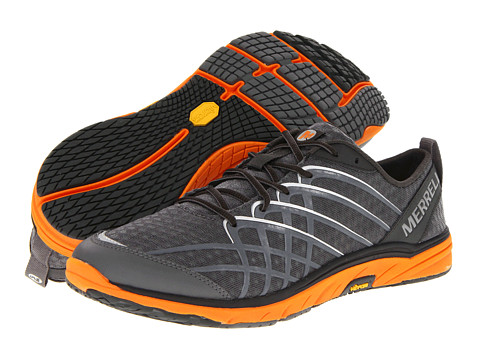
Luckily, Merrell has another model that's a step up in structure from the Vapor Glove called the Bare Access 2. I really liked these shoes, but their additional padding is pretty dense, firm and tough. It's not as noticeable running as it is walking, but it transmits most of the shock into your foot, and definitely takes some work to get a good plantar flexion of the foot going, even if you aren't aware of it. That can tire your feet muscles, aggravate your joints and inflame your nerves. This happened to me in the Bare Access 2 the first time I consistently ran over 4 miles (3 times in a week).

Merrell Bare Access 2
So I went to Merrell's sister company, Saucony, and got a shoe that is basically universally loved by
Saucony Kinvara 4
runners and reviewers, and had just been redesigned to even more positive praise, the Kinvara (version 4, this time). This was the first traditional-looking shoe I had bought in a long time. It had real cushioning, which I was looking for, but didn't have a wide toe box or sole design that would facilitate toe striking. I was concerned, but tried them on, and found they felt fine on both counts. I did find in runs that I need to really push myself to get a good toe strike - at least at first until I found a good rhythm. This was new to me. The easiest thing to do with them was heel strike, or maybe mid-foot strike.

The cushioning really was great, and I've generally liked the shoe a lot. However, as I ran more and more in them (both in terms of frequency and distance), I found my metatarsal pain was a frequent issue despite the cushioning, and I had started to get Achilles tendon pain, which I've never had. I saw my PT, who suggested a few things, which generally helped, but only until I ran again (even if I took a week off and really let the pain die down or away completely).

I realized the issue. Yes, you can toe strike in both the Bare Access 2 and Kinvara, but the effort it takes to do so was having an impact on my feet and Achilles.  I'm a FFS runner, and most shoes in the minimal or natural category (save for the ultra-minimalist stuff like the Vapor Gloves and VFFs) really are best for mid-foot strikers. And most traditional shoes are very MFS-friendly (that is, you should be able to mid-foot strike just fine, despite their ramp-like construction).

Mizuno Cursoris
So what to do? I need to stick to shoes more like the Gazelles in their construction, but perhaps with a touch more structure to ensure my foot can't slide out within the shoe in weird ways. I've recently picked up a pair of Mizuno Wave Evo Cursoris, and, if you follow me on Twitter, you know that I'm totally smitten. I need to get more miles on them overall and in a single run, but they might be the perfect mix of cushion (18mm), easy-flexibility and sufficient structure for me. I want to get in a longer #CUYOP run next week in the 7-12 mile range (if not two in one day) to really see, but every stride has really been a joy. I also did my fastest mile (high-6s) in them, and have been able to get my pace back into the mid-8s when it's been stuck in the high-8s/low-9s for a while.  I actually had to consciously slow down on a 3.5 miler this week when I saw my pace was in the low 7s - I'm not trying to get injured, but rather an training for a half marathon.

My point is to take some time and really think about how your body wants to run. I can get preachy and tell you how it should run, but it's not about me and my beliefs or wants. It's about you and yours. You can buy a bunch of shoes to try them and see what's best, or you can think a bit up front, and let that define the must-have features. Just don't be afraid to adjust and learn as your body adjusts and learns. Learning is how your enlighten.your.body.