Q: What is newbodi.es about? Are you about personal training? Life coaching? Diet ideas? Energy bars? What?
A: Simple, we're about whole fitness.
OK, maybe it's not quite that simple, or maybe that doesn't actually explain things. By 'whole fitness', I mean that we are about being healthy in every way, shape and form. newbodi.es aim is to help people transform their complete life into a higher level of health. This means focusing on the body (exercise and dietary habits), but going beyond that into the mind and how we live our lives.
So, yes, we are about personal training. We are about life coaching. We do give diet advice and guidance, and do offer 'energy' bars (if you can call them that - they're really nutrition bars). But the key is what we do to offer these things in an intertwined, holistic manner.
You can be physically fit, and still overall 'unhealthy' because you are overwhelmed by stress, pessimism and anxiety. That is not living healthily. That is living under a cloud (at best). The flip side of this is that you can be mentally very healthy and happy, but your body isn't at the same place, so you live a limited life (either by what your body can't do, how hard it is to do what you want, or quite literally that your life is limited in how long it is due to health factors). That physical health cannot just come from exercise or food choices alone, but rather the combination of the two. Improve the machine while giving it the right fuel for its needs and eliminating the poisons that work against it.
Focusing on any one aspect of health will only provide a local maxima. This is like being in a valley between two hills, and seeing those hills as the highest points around. You can pick which of the two is tallest, and think that's the highest point you can achieve. But if you change your perspective, get out of the valley and see all the peaks around you, then you can find the global maxima. Only then can you achieve it. Fitness is a valley. Diet is a valley. Working on your mind is a valley. Rise above and see across all of them to find the true summit. Climbing that summit is how you enlighten.your.body.
Saturday, September 14, 2013

Monday, September 2, 2013
Getting Jiggly with It (aka Proprioceptively Enriched Environments)
Proprioception. What is it? A pill that is meant to help with baldness? No, that's Propecia. Sweating? Nope - perspiration. It's about instability, and your body's ability to stay balanced by sensing what it needs to do in response to the instability and then doing it.
The definition of it from the National Academy of Sports Medicine (of which I'm a Certified Personal Trainer) is:
Creating a proprioceptive rich environment to workout in is a way to increase the difficulty of an exercise. If you don't increase the difficulty or intensity, you won't keep progressing, so this is a good thing to know as you master an exercise at a given level of difficulty. Most people think, "I need to add a few minutes/miles/pounds to my exercise," to make it tougher, but here's another way to keep getting results from your efforts.
It's not about 'more', but rather 'many'. By that I mean it isn't about doing the same exercise with more weight, moving farther or being more powerful in your movement. Rather, it's about how many things you're asking of your body in the process of the movement. So with a squat, it isn't that you're now wearing a weight vest, holding dumb bells, going down deeper or explosively charging back up. It's about activating all the muscles from your core to your toes to help keep you balanced, and asking your prime movers (quads, hamstrings) to activate more broadly and more finitely at the same time (triggering more of the muscle, and using each fiber more acutely). There's nothing wrong with 'more', but 'many' can do more for you depending on your current fitness level and goals. It's also more likely to give you usable benefits for everyday life.
Combine more and many, and you're in a great position, but you have to work up to that. But that's the whole point of making progress. Work up to many, more and better. That's what it means to enlighten.your.body.
The definition of it from the National Academy of Sports Medicine (of which I'm a Certified Personal Trainer) is:
The cumulative sensory input to the central nervous system from all mechanoreceptors that sense body position and limb movements.See? Just like I said. It's your body's ability to deal with the undulations under foot (or other body part that's responsible for balance or movement). An extreme but clear example would be walking on a tight rope or a slack line. A simpler example would be running on something other than a paved surface like sand or a trail.
Creating a proprioceptive rich environment to workout in is a way to increase the difficulty of an exercise. If you don't increase the difficulty or intensity, you won't keep progressing, so this is a good thing to know as you master an exercise at a given level of difficulty. Most people think, "I need to add a few minutes/miles/pounds to my exercise," to make it tougher, but here's another way to keep getting results from your efforts.
It's not about 'more', but rather 'many'. By that I mean it isn't about doing the same exercise with more weight, moving farther or being more powerful in your movement. Rather, it's about how many things you're asking of your body in the process of the movement. So with a squat, it isn't that you're now wearing a weight vest, holding dumb bells, going down deeper or explosively charging back up. It's about activating all the muscles from your core to your toes to help keep you balanced, and asking your prime movers (quads, hamstrings) to activate more broadly and more finitely at the same time (triggering more of the muscle, and using each fiber more acutely). There's nothing wrong with 'more', but 'many' can do more for you depending on your current fitness level and goals. It's also more likely to give you usable benefits for everyday life.
Combine more and many, and you're in a great position, but you have to work up to that. But that's the whole point of making progress. Work up to many, more and better. That's what it means to enlighten.your.body.
Sunday, September 1, 2013
Recipe: Green Eggs
 I've given a lot of breakfast advice over the past couple of years with a focus on getting 30 grams of protein within 30 minutes of waking (read this Q&A post for some thoughts on the matter). This seems to be a real sticking point for people who aren't used to eating breakfast, or, if they are, they eat something fast, cold and simple (bagel, cereal, muffin, etc). The idea of cooking breakfast sounds way too hard, and the idea of having eggs every morning sounds way too unhealthy. You have it backward in terms of the health point. As for it being hard, yeah, you've got me there. The good news is, I have a solution.
How is it that I eat a multi-ingredient omelet every morning around 5am without making so much noise that I wake up my whole household? How do I do it without having to cook on top of trying to workout, do some work, shower, get dressed and get out the door to get to my office? The answer is really simple - I cook the omelet at night, and employ my economics undergrad degree a bit by leveraging economies of scale. In non-dork terms, I make more than one omelet at a time. Sometimes, I don't even make an omelet, but do more of a fritada so I can just stick it in the oven for 20 minutes and not even have to think about it (or clean the dish for a few days).
OK, here's the deal. You need an egg for each day you're cooking for, some egg whites, powdered greens (optional, but highly recommended since they're SO good for you), spinach, onions or scallions, chia seeds, mushrooms, cayenne, salsa, sea salt, a kitchen sink and anything else you want in your omelet. Be sure to skip cheese, milk and anything you don't want in your omelet. I tend to make enough for five or six breakfasts, so I use that many whole eggs, and then probably another cup to two cups of egg white added in.
 Start with cracking the eggs into a bowl. Add a scoop of greens for each day's worth of breakfast (e.g. five scoops for five breakfasts). I find stirring the greens in after each scoop is best for avoiding clumps. A mini whisk is ideal, but I fork will work ok. If you get some lumps, don't worry too much, but generally try to minimize how many lumps you get. Also add any seasoning (salt, cayenne) at this point. After you have all the greens in, add in your egg whites, and stir it all together some more to help mix it and break down any remaining lumps.
 In a sauce pan, sauté the veggies a bit as they won't cook sufficiently for most people's taste once in the egg mixture. Add the spinach (or kale, if you like) half way through. Sprinkle chia seeds on top, and then pour the eggs in. If you're doing this in a quiche dish as a frittata, pour the veggies into the dish, spread them, and then sprinkle on the chia seeds. Chia seeds are a great source of fiber and energy. They're good to work into your diet, and this is an easy way to do so. A nice optional ingredient is salsa or pico de gallo. Just drain the liquid off, or let it burn off during the cooking process. Tomatillo sauce is also a nice addition. Really, just play around to suit your preferences and taste, and to help differ things from week to week.
Next, pour in the egg mixture. If it isn't enough to cover the veggies, add some more egg white. I felt like a little more spinach was in order, so I pressed some down into the mixture, but that's basically it. You can cover it and let it cook on medium or medium-low heat for 5-10 minutes (until the middle isn't liquidy), or stick the quiche dish in the oven at 375 for 15-20 minutes (checking that it looks cooked throughout). The time will depend on the depth/thickness, so adjust for your situation. I find lower heat for longer time works better than trying to cook it hot and fast.
 When it's done, let it cool, and then just cut it into wedges that look like a good portion for you to eat at breakfast. Depending on the size of the pan or quiche dish and the thickness of the frittata or omelet, I find I get five or six portions out of it. My breakfast routine consists of a wedge of that warmed in the toaster oven (15 minutes at 275 or so) or microwave (1:30 on high is usually good) plus a protein shake and a couple of newbodi.es 4hb slow carb bars. Sometimes I'll also make lentils to along with it, and only eat one slow carb bar.
A tasty, good for you, protein-packed way to enlighten.your.body first thing in the morning.
Review: Mizuno Wave Evo Cursoris Has a Weird Name But Rocks
The buildup
 I have been searching for the perfect shoe for me for a while. I thought I had it in the Adidas adipure Gazelle. They are amazing, and I love them, but they wear out way too fast for me, and I end up feeling like I'm running off the edge of them because of how badly the upper has stretched (within 50 miles, no less!). I thought I had them in the Merrell Bare Access 2. They're great, but I found the sole to be a bit stiff, causing forefoot pain when toe striking, and the form is a little too rigid, allowing for some slop in the toe box. They are really good shoes, though, but not perfect.
I've been seeing things about the Mizuno Wave Evo Cursoris, and waiting for RunBlogger to review them because Pete and I seem to have similar preferences in shoes. He finally did, and I didn't hesitate to pick up a pair (on closeout for the Halloween color version from RunningWarehouse.com - great deal).
All I can say is that I'm done. The search is over. I think. Read on to understand.
What it is & How it works
The Wave Evo Cursoris is one of two shoes Mizuno came out with this year to feature truly anatomical design and minimalism philosophy at play (the other is the racing shoe, the Wave Evo Levitas, which I'd love to try for my next 5K or 10K - hint hint, Mizuno, can send me a pair to review?). The shoes look adequately weird, and have a terrible name. Both good traits in running shoes in my book.
 They are narrowish around the heel, and come out around the toes, with a really nicely shaped and sized toe box that looks like the shape of the foot. I don't know anyone with a foot the shape of most running shoes, but I know pretty much no one with feet that aren't shaped like these.
The Cursoris (I don't have time to write out their full name, ok?) has fantastic flex, and a nicely cushioned 18mm sole that has no drop between the forefoot and heel. The lacing has a slight bias so that it follows the movement patterns of the metatarsals rather than cutting across them. Another good design move. The shoe came in a couple of bad colors (green and blue or orange and black), and has this weird lizard/leopard/flower pattern on a few parts. They discontinued these colors and moved to a white, black and blue scheme that's really nice looking. I have the Halloween editions, and basically don't mind if my running shoes are majorly fugly because that only adds to the power with which I shout out that I am a runner (silently shout, that is).

Another thing to note about them is that they run larger. I used the awesome Shoefitr system on Running Warehouse's site to find my size since I couldn't find a local shop that had them to know what size I needed. I put in my Gazelles in size 10 as the comparison point, as they fit me perfectly. Shoefitr said I needed 9.5s. They were spot on for fit. I've never worn other Mizunos, so I can't say if they all run large or if it's just the Cursoris, but you should either try them on or use Shoefitr. I've found Shoefitr to be a total life saver when ordering shoes online or even buying locally with a try-on as new shoes don't always fit the same after a little break in (I should have listened to Shoefitr when I bought the Kinvaras - it said go with a 10, but I felt the 10.5s fit better...after about 5 miles, I realized that was a mistake, but I couldn't return them).
My impressions
Seriously, these are the best running shoes I've ever owned. They're fantastic, and only get more fantastic the faster I run in them. I've put about 50 miles on them so far, with runs ranging from two miles to 9 miles. They're fine at 9+ minute pacing and outstanding at sub-7s. I really notice how they are just primed to respond when I need to really kick it into high gear. It's like their structure is made to go faster and faster, and they're just waiting for me to hit the turbo button on my legs.
 I ran my fastest mile ever at about 6'50" the first time I ran with them. Then, on a 9-miler, I had to cut across a busy street really quickly about 3 miles into the run. I had been doing maybe 8'15" pacing so far with the Cursoriseseseses (not sure what the plural is, but it probably isn't that - maybe Cursorii like Toyota Prii) proving good traction, flexibility, fit and cushioning without being obvious or obtrusive in any way. When I called on my legs to sprint across the street (probably a 50 yard sprint - nothing major), the shoes felt like something different than they had been. They gripped even better without being overly grippy (I can't describe too well - they just give immense confidence without feeling too tacky), lightened up, flexed more, and the cushioning just seemed to know what I needed of it. They also disappeared even more on my feet at the same time. Yes, they're magic, if that's what you were wondering.
The funny thing about them is how they feel when standing or walking. That is to say, not great. The sole is fine, and the shoe is light and airy, but there is a feeling of some sort of constricting seam or band over my forefoot (a little behind the toes, yet forward of where the laces end and the material changes, which is where I would expect to feel it). I was concerned about this for my first run, but as soon as I took off, they felt 100% invisible. I've heard people talk about shoes disappearing under foot, but figured that was a BS marketing line or something. I now know what that feels like.
 I ran my fastest mile ever at about 6'50" the first time I ran with them. Then, on a 9-miler, I had to cut across a busy street really quickly about 3 miles into the run. I had been doing maybe 8'15" pacing so far with the Cursoriseseseses (not sure what the plural is, but it probably isn't that - maybe Cursorii like Toyota Prii) proving good traction, flexibility, fit and cushioning without being obvious or obtrusive in any way. When I called on my legs to sprint across the street (probably a 50 yard sprint - nothing major), the shoes felt like something different than they had been. They gripped even better without being overly grippy (I can't describe too well - they just give immense confidence without feeling too tacky), lightened up, flexed more, and the cushioning just seemed to know what I needed of it. They also disappeared even more on my feet at the same time. Yes, they're magic, if that's what you were wondering.
The funny thing about them is how they feel when standing or walking. That is to say, not great. The sole is fine, and the shoe is light and airy, but there is a feeling of some sort of constricting seam or band over my forefoot (a little behind the toes, yet forward of where the laces end and the material changes, which is where I would expect to feel it). I was concerned about this for my first run, but as soon as I took off, they felt 100% invisible. I've heard people talk about shoes disappearing under foot, but figured that was a BS marketing line or something. I now know what that feels like.
My depressions
 Honestly, I'm really struggling here to find things that concern me. I may have a list after doing 100-150 miles on them, but there's nothing at all that's worrying me. The only potential thing I see is how fast the sole will wear. The cushioning is largely dense EVA (see the white sections of the sole shot here - though there's a white rubber insert on the heel, as are the green pods), and sure enough, it's wearing already. I am in the middle of recovering from knee surgery, so I know my gait is a bit off, which is why one shoe is wearing faster than the other as I tend to turn my foot a bit on impact. That said, so many people have muscle imbalances, so it's not like everyone else runs perfectly. I don't notice it while running, but can blatantly see the wear when I look at the sole. Oddly enough, it's smack in the middle of the mid-foot (first white pod to the left of the wide green one in the shot above, sort of sandwiched between the lateral and medial green pods of the mid-foot). You'd think it would be an outer or inner pod, but it's not. This goes to the rotation I have in my stride.
I have three pairs of Gazelles that are almost unusable after 40 miles due to the upper stretching out too much, so I'm not at all unhappy with how the Cursoris is holding up. I'm sure I'll be able to get somewhere between 150 and 200 miles on them. For the $60ish I paid for them on close out, I'd say that's a damn good value.
To buy or not to buy?
Buy them. 'Nuff said.
OK, not really enough said. I really do love running in these shoes. I'm side-lined with tendonitis in my left big toe right now (not from these - it started before I bought them, and is possible because I was trying to forefoot strike in my Saucony Kinvara's, which just aren't flexible enough for my stride), so I'm really antsy to get back out on them.
OK, not really enough said. I really do love running in these shoes. I'm side-lined with tendonitis in my left big toe right now (not from these - it started before I bought them, and is possible because I was trying to forefoot strike in my Saucony Kinvara's, which just aren't flexible enough for my stride), so I'm really antsy to get back out on them.

I am bummed that I didn't order 2 pairs when I got them as they're now out of my size in the orange and black ones, and I don't like the green and blue, and don't want to pay full price for the white and black (which look really sharp). If I am going to still run the half marathon I have planned for October, I'll need a new pair. I'll probably go for the white and black to give me a little amping up for the race. Maybe some good coupons will come out by early October or maybe Mizuno or Running Warehouse will just the coolest companies and throw me a pair out of the goodness of their hearts. Yeah, probably the former, though they're both cool companies.
The Cursoris is literally the best shoe I've ever run in. Find something that you truly enjoying running in. It's out there. The Cursoris may just be that shoe for you, too. It will help you enlighten.your.body.
Monday, August 26, 2013
Don't Silence Your Inner Fat Kid - Control & Use It
As a former fat kid, I found myself stuck in how I viewed myself. That is, after I lost weight, I still saw myself as 'the fat kid'. I worked really hard to see myself as I actually was rather than as I used to - essentially silencing my past as a part of my present and future. As I've now been thinner longer than I was fat, I have a new perspective on things that I think is valuable to share.
I was 248 lbs at the height of my obesity, at age 17. There was a distinct rotundness to my shape, and my height (6'2" - not giant, but taller than most kids in my school) drew even more attention to my proportions. I lost most of the weight the summer before my senior year, and really toned up through that year. I didn't really see myself as this in-shape or good looking guy because I never saw myself that way (justifiably), and the people around me had always known me as 'the fat kid'. My whole environment had sort of type-cast me, if you will. And people had always complimented me to be nice (e.g. my mother saying something like, "You look so handsome in that suit."), so the compliments I started to get after losing weight sort of rolled off my back as niceties no one actually meant. They were just being polite.
As for girls, none in my environment were interested because they had formed a bullet-proof sense of me as unfit, unattractive, unathletic, uncool. If I was at a party with kids from another school, and a girl showed interest in me, I didn't have a clue what to do about it, and didn't usually even pick up on it. I mean, why would she, right?
Fast forward to college - new kids, no one with a pre-determined sense of me. That is, no one but me. I worked on how I viewed myself while in college, and did so by basically ignoring who I had been rather than finding a way to really deal with it or take power from it.
This is the key.
Like anything we go through in life, the right way of dealing with it is never to not deal with it. If that sentence didn't read right to you or didn't make sense, go back and re-read it. I didn't mistype it. You cannot suppress or ignore things that happened and ultimately expect to move on completely. That doesn't mean you can't have a good life or be happy, but just that you won't have truly dealt with it or faced the issue. If you can successfully do that, you will be in a much better place than you could have been if you just suppressed or ignored.
There are obviously much tougher situations than childhood obesity that people go through, and I'm not saying it's easy to deal with any of this. But being 'the fat kid' is easier than we may allow it to be - ridicule, self-doubt, lack of self-worth and all. They key is to take power from it.
So what does this mean? For me, it's about remember who I have been, and what I've done to get to where I am. Not just physically, but mentally - especially mentally. I wasn't fat because of physical reasons. I was fat because of mental. My understanding, my mental strength, my emotional strength and my sense of what I was worth. Looking at what I am today feels great, but doing it in light of what I was before feels immensely better.
I let that fat kid in me live. I seek to understand why I ate how I ate and had the attitude I did toward physical activity and being outside. It is because I allow those thoughts into my head so that I can understand them that I'm able to move on from them and do better. If I didn't, I wouldn't have the tools to deal with them should those feelings crop up again.
As an example, I didn't like exercise because it was always done to me rather than something I chose to do for me. That really is the root of my feelings toward it. It's about choice. Now I choose to do it. And I choose what to do. I didn't want to play soccer as a kid, but my brother, father and mother made me. Now, I don't mind playing it, but if I don't want to, I do something else. And I've come to understand who the exercise is for. It's not because my father is mad at my weight, or my sister is making fun of me for being fat and lazy. It's also not even because I want to look good for my wife (who is beyond out of my league), or to be a good role model for my son. It's because I feel amazing doing it for me. That high I get from doing for myself is why I do it. But it took breaking down my deep-rooted feeling toward exercise to understand why I disliked it, and try to look at it another way. Looking at it another way took structuring my approach to it differently. None of this would have come if I had just suppressed my past feelings.
I know because that was my old approach. I exercised through most of my 20s, and I did it because I was afraid of getting fat again and because I wanted people to like me. I wanted to find a wife, and I'd never do that if I was fat (obviously, this is flawed thinking, but that's what was coursing through my mind). I did it, essentially, out of fear. And I wound up taking months off at a time because I'd be burnt out on it (and I did maybe 20% as much exercise as I do now, and slept twice as much, so it wasn't due to physical exhaustion).
Let the fat kid in you live. Become his or her friend. Understand what motived good and not good choices and behaviors at a very deep level. Break this down into understanding how you can use it to help you today. We are who we have been, and we can only move ahead by allowing for that to be ok and to grow from it. Go ahead - enlighten.your.body.
I was 248 lbs at the height of my obesity, at age 17. There was a distinct rotundness to my shape, and my height (6'2" - not giant, but taller than most kids in my school) drew even more attention to my proportions. I lost most of the weight the summer before my senior year, and really toned up through that year. I didn't really see myself as this in-shape or good looking guy because I never saw myself that way (justifiably), and the people around me had always known me as 'the fat kid'. My whole environment had sort of type-cast me, if you will. And people had always complimented me to be nice (e.g. my mother saying something like, "You look so handsome in that suit."), so the compliments I started to get after losing weight sort of rolled off my back as niceties no one actually meant. They were just being polite.
As for girls, none in my environment were interested because they had formed a bullet-proof sense of me as unfit, unattractive, unathletic, uncool. If I was at a party with kids from another school, and a girl showed interest in me, I didn't have a clue what to do about it, and didn't usually even pick up on it. I mean, why would she, right?
Fast forward to college - new kids, no one with a pre-determined sense of me. That is, no one but me. I worked on how I viewed myself while in college, and did so by basically ignoring who I had been rather than finding a way to really deal with it or take power from it.
This is the key.
Like anything we go through in life, the right way of dealing with it is never to not deal with it. If that sentence didn't read right to you or didn't make sense, go back and re-read it. I didn't mistype it. You cannot suppress or ignore things that happened and ultimately expect to move on completely. That doesn't mean you can't have a good life or be happy, but just that you won't have truly dealt with it or faced the issue. If you can successfully do that, you will be in a much better place than you could have been if you just suppressed or ignored.
There are obviously much tougher situations than childhood obesity that people go through, and I'm not saying it's easy to deal with any of this. But being 'the fat kid' is easier than we may allow it to be - ridicule, self-doubt, lack of self-worth and all. They key is to take power from it.
So what does this mean? For me, it's about remember who I have been, and what I've done to get to where I am. Not just physically, but mentally - especially mentally. I wasn't fat because of physical reasons. I was fat because of mental. My understanding, my mental strength, my emotional strength and my sense of what I was worth. Looking at what I am today feels great, but doing it in light of what I was before feels immensely better.
I let that fat kid in me live. I seek to understand why I ate how I ate and had the attitude I did toward physical activity and being outside. It is because I allow those thoughts into my head so that I can understand them that I'm able to move on from them and do better. If I didn't, I wouldn't have the tools to deal with them should those feelings crop up again.
As an example, I didn't like exercise because it was always done to me rather than something I chose to do for me. That really is the root of my feelings toward it. It's about choice. Now I choose to do it. And I choose what to do. I didn't want to play soccer as a kid, but my brother, father and mother made me. Now, I don't mind playing it, but if I don't want to, I do something else. And I've come to understand who the exercise is for. It's not because my father is mad at my weight, or my sister is making fun of me for being fat and lazy. It's also not even because I want to look good for my wife (who is beyond out of my league), or to be a good role model for my son. It's because I feel amazing doing it for me. That high I get from doing for myself is why I do it. But it took breaking down my deep-rooted feeling toward exercise to understand why I disliked it, and try to look at it another way. Looking at it another way took structuring my approach to it differently. None of this would have come if I had just suppressed my past feelings.
I know because that was my old approach. I exercised through most of my 20s, and I did it because I was afraid of getting fat again and because I wanted people to like me. I wanted to find a wife, and I'd never do that if I was fat (obviously, this is flawed thinking, but that's what was coursing through my mind). I did it, essentially, out of fear. And I wound up taking months off at a time because I'd be burnt out on it (and I did maybe 20% as much exercise as I do now, and slept twice as much, so it wasn't due to physical exhaustion).
Let the fat kid in you live. Become his or her friend. Understand what motived good and not good choices and behaviors at a very deep level. Break this down into understanding how you can use it to help you today. We are who we have been, and we can only move ahead by allowing for that to be ok and to grow from it. Go ahead - enlighten.your.body.
Saturday, August 3, 2013
Hey, Adidas, stop it, ok?
 |
| Adidas Springblade |
Aside from selling the things, Adidas has a noble goal of decreasing joint pain and increasing endurance by cushioning impact and deploying more kinetic energy per stride. I'll also add that I love to see that they're using their Techfit upper in the Springblade, which I've found to be comfortable and compliant with different foot shapes (though the toe cap seems to negate the real benefit of the upper since it will restrict the toes from splaying and naturally providing stability).
My issue starts with how the body will react to these two models. Several reviews of the Energy Boost have raised concerns with the unpredictable nature of the energy return, like running on a trampoline. This screws with your body's ability to sense angles, balance and forces, and fire muscles appropriately (aka proprioception). There are arguments for training in proprioceptively rich (aka unstable) environments as it strengthens the minor support muscles around your joints and builds the primary movers in a wider range than overly-controlled exercise. That said, these aren't positioned as proprioceptive trainers (like a Bosu or balance disc is). They're positioned as running shoes you could run a race in.
For the Springblades, I'm even more concerned because they really force you down one path - heel striking, and they look to snap you ahead a bit as the plastic blades spring back. That can't be good for the knees - knees that have just taken a jolt from the heel strike you can't avoid in these things. I'm sure you could mid-foot strike in them, but I would imagine you'll get an odd jolt from the heel blades when they touch and spring back which would put an odd strain on a knee that isn't expecting return forces from heel striking to come when it isn't heel striking.
The Energy Boost are also so thick in the back and rigidly constructed under the forefoot that I can't these being forefoot strikable. I'm sure you can mid-foot strike in them, though.
 |
| Adidas Energy Boost |
The shoes look really cool (especially the Springblades), and I'm sure will sell fine. However, they're both very expensive ($180 for Springblades (!) and $150 for Energy Boost), so I really think the burden of proof of the true benefit of the technology needs to be there. Cushioning or energy return may be good, but before you ask me to spend more than any other competitor shoe I've seen on the market, perhaps you could really show me why and how it's good.
This all reminds me of a similar situation in the opposite direction. Vibram FiveFingers came out with a lot of claims of being better without a lot of proof of this being true. Those claims as taken by the average consumer imparted a sense of health benefit or at least benefit to running and injury reduction. No proof has emerged, and injuries have still been experienced by VFF wearers. The result was a class action lawsuit that Vibram lost. Notice the analogs here - claims that the tech is better for you and will help your body, yet a lack of proof. For some reason, the media was all over Vibram for its claims, but no one in the mainstream sports media seems to be pointing out what Adidas is doing here.
I'm not trying to be a conspiracy theorist or anything, but I'm saying people need to be mindful of claims without proof, and the trend of the big sports companies to generally isolate the body from the sport with excessive cushioning and technology to do the work for us (like blades from Adidas or shocks from Nike that spring us forward so we don't have to).
Removing yourself from your exercise isn't a great way to be healthy. Get closer to it, let your body do what it's made to do, smile and enlighten.your.body.
FFS in a MFS Shoe Market
I run on my toes. Not my tippy toes, but my forefeet. I've tried to get back onto my mid-foot, which I can, but it isn't as natural or comfortable for me. I've tried heel striking, but it hurts my whole body - especially when I'm in really minimal shoes. As I've been going for more distance, I find myself wishing for more padding than my favorite shoes tend to have as I have been getting some nerve pain between my metatarsals.
For the non-medical types reading this (like me), a key to forefoot striking, or FFS, is plantar flexion of the foot. This is when you flex the toes down toward the ground, and point the foot. The opposite is called dorsiflexion, and it's what a heel striking would do as they extend their foot to get the heel on the ground first. See this lovely graphic on the right? I'm the lower image (though my toes aren't pointed, least they break off on impact).
So I've tried a few shoes that are generally well-received. Moving up from Vibram FiveFingers into a padded minimalist shoe, I fell in love with the Adidas Adipure Gazelle (read my review of them here). I thought they would be and remain my favorite shoe, but as I broke through 40 miles on them, I found I was having lots of knee pain and blistering as they weren't keeping my foot aligned over the footbed given their unstructured upper. That's just too short of a life. I still love them, but I have to pick times to wear them when I know my legs are feeling good and strong so I can maintain my form. They're also just fine for treadmill runs, which remove all of the pivoting and uneven loads of outdoor running (a good reason to avoid the treadmill!).
I tried Merrell Vapor Gloves, which are basically like Vibrams, but without individual toes. They're ok, but not really what I was looking for in terms of padding since, well, they have none.
Luckily, Merrell has another model that's a step up in structure from the Vapor Glove called the Bare Access 2. I really liked these shoes, but their additional padding is pretty dense, firm and tough. It's not as noticeable running as it is walking, but it transmits most of the shock into your foot, and definitely takes some work to get a good plantar flexion of the foot going, even if you aren't aware of it. That can tire your feet muscles, aggravate your joints and inflame your nerves. This happened to me in the Bare Access 2 the first time I consistently ran over 4 miles (3 times in a week).
So I went to Merrell's sister company, Saucony, and got a shoe that is basically universally loved by
runners and reviewers, and had just been redesigned to even more positive praise, the Kinvara (version 4, this time). This was the first traditional-looking shoe I had bought in a long time. It had real cushioning, which I was looking for, but didn't have a wide toe box or sole design that would facilitate toe striking. I was concerned, but tried them on, and found they felt fine on both counts. I did find in runs that I need to really push myself to get a good toe strike - at least at first until I found a good rhythm. This was new to me. The easiest thing to do with them was heel strike, or maybe mid-foot strike.
The cushioning really was great, and I've generally liked the shoe a lot. However, as I ran more and more in them (both in terms of frequency and distance), I found my metatarsal pain was a frequent issue despite the cushioning, and I had started to get Achilles tendon pain, which I've never had. I saw my PT, who suggested a few things, which generally helped, but only until I ran again (even if I took a week off and really let the pain die down or away completely).
I realized the issue. Yes, you can toe strike in both the Bare Access 2 and Kinvara, but the effort it takes to do so was having an impact on my feet and Achilles. I'm a FFS runner, and most shoes in the minimal or natural category (save for the ultra-minimalist stuff like the Vapor Gloves and VFFs) really are best for mid-foot strikers. And most traditional shoes are very MFS-friendly (that is, you should be able to mid-foot strike just fine, despite their ramp-like construction).
So what to do? I need to stick to shoes more like the Gazelles in their construction, but perhaps with a touch more structure to ensure my foot can't slide out within the shoe in weird ways. I've recently picked up a pair of Mizuno Wave Evo Cursoris, and, if you follow me on Twitter, you know that I'm totally smitten. I need to get more miles on them overall and in a single run, but they might be the perfect mix of cushion (18mm), easy-flexibility and sufficient structure for me. I want to get in a longer #CUYOP run next week in the 7-12 mile range (if not two in one day) to really see, but every stride has really been a joy. I also did my fastest mile (high-6s) in them, and have been able to get my pace back into the mid-8s when it's been stuck in the high-8s/low-9s for a while. I actually had to consciously slow down on a 3.5 miler this week when I saw my pace was in the low 7s - I'm not trying to get injured, but rather an training for a half marathon.
My point is to take some time and really think about how your body wants to run. I can get preachy and tell you how it should run, but it's not about me and my beliefs or wants. It's about you and yours. You can buy a bunch of shoes to try them and see what's best, or you can think a bit up front, and let that define the must-have features. Just don't be afraid to adjust and learn as your body adjusts and learns. Learning is how your enlighten.your.body.
 |
| Adidas adiPure Gazelle 2 |
For the non-medical types reading this (like me), a key to forefoot striking, or FFS, is plantar flexion of the foot. This is when you flex the toes down toward the ground, and point the foot. The opposite is called dorsiflexion, and it's what a heel striking would do as they extend their foot to get the heel on the ground first. See this lovely graphic on the right? I'm the lower image (though my toes aren't pointed, least they break off on impact).
 |
| Merrell Vapor Glove |
I tried Merrell Vapor Gloves, which are basically like Vibrams, but without individual toes. They're ok, but not really what I was looking for in terms of padding since, well, they have none.
Luckily, Merrell has another model that's a step up in structure from the Vapor Glove called the Bare Access 2. I really liked these shoes, but their additional padding is pretty dense, firm and tough. It's not as noticeable running as it is walking, but it transmits most of the shock into your foot, and definitely takes some work to get a good plantar flexion of the foot going, even if you aren't aware of it. That can tire your feet muscles, aggravate your joints and inflame your nerves. This happened to me in the Bare Access 2 the first time I consistently ran over 4 miles (3 times in a week).
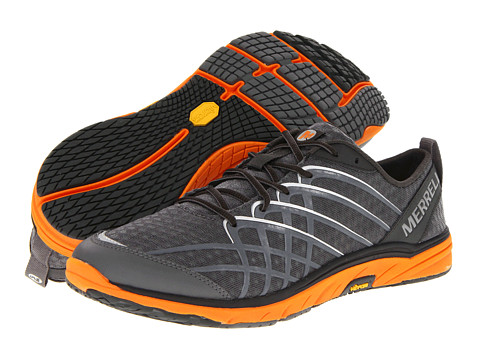 |
| Merrell Bare Access 2 |
 |
| Saucony Kinvara 4 |
The cushioning really was great, and I've generally liked the shoe a lot. However, as I ran more and more in them (both in terms of frequency and distance), I found my metatarsal pain was a frequent issue despite the cushioning, and I had started to get Achilles tendon pain, which I've never had. I saw my PT, who suggested a few things, which generally helped, but only until I ran again (even if I took a week off and really let the pain die down or away completely).
I realized the issue. Yes, you can toe strike in both the Bare Access 2 and Kinvara, but the effort it takes to do so was having an impact on my feet and Achilles. I'm a FFS runner, and most shoes in the minimal or natural category (save for the ultra-minimalist stuff like the Vapor Gloves and VFFs) really are best for mid-foot strikers. And most traditional shoes are very MFS-friendly (that is, you should be able to mid-foot strike just fine, despite their ramp-like construction).
 |
| Mizuno Cursoris |
My point is to take some time and really think about how your body wants to run. I can get preachy and tell you how it should run, but it's not about me and my beliefs or wants. It's about you and yours. You can buy a bunch of shoes to try them and see what's best, or you can think a bit up front, and let that define the must-have features. Just don't be afraid to adjust and learn as your body adjusts and learns. Learning is how your enlighten.your.body.
Subscribe to:
Posts (Atom)