As a former fat kid, I found myself stuck in how I viewed myself. That is, after I lost weight, I still saw myself as 'the fat kid'. I worked really hard to see myself as I actually was rather than as I used to - essentially silencing my past as a part of my present and future. As I've now been thinner longer than I was fat, I have a new perspective on things that I think is valuable to share.
I was 248 lbs at the height of my obesity, at age 17. There was a distinct rotundness to my shape, and my height (6'2" - not giant, but taller than most kids in my school) drew even more attention to my proportions. I lost most of the weight the summer before my senior year, and really toned up through that year. I didn't really see myself as this in-shape or good looking guy because I never saw myself that way (justifiably), and the people around me had always known me as 'the fat kid'. My whole environment had sort of type-cast me, if you will. And people had always complimented me to be nice (e.g. my mother saying something like, "You look so handsome in that suit."), so the compliments I started to get after losing weight sort of rolled off my back as niceties no one actually meant. They were just being polite.
As for girls, none in my environment were interested because they had formed a bullet-proof sense of me as unfit, unattractive, unathletic, uncool. If I was at a party with kids from another school, and a girl showed interest in me, I didn't have a clue what to do about it, and didn't usually even pick up on it. I mean, why would she, right?
Fast forward to college - new kids, no one with a pre-determined sense of me. That is, no one but me. I worked on how I viewed myself while in college, and did so by basically ignoring who I had been rather than finding a way to really deal with it or take power from it.
This is the key.
Like anything we go through in life, the right way of dealing with it is never to not deal with it. If that sentence didn't read right to you or didn't make sense, go back and re-read it. I didn't mistype it. You cannot suppress or ignore things that happened and ultimately expect to move on completely. That doesn't mean you can't have a good life or be happy, but just that you won't have truly dealt with it or faced the issue. If you can successfully do that, you will be in a much better place than you could have been if you just suppressed or ignored.
There are obviously much tougher situations than childhood obesity that people go through, and I'm not saying it's easy to deal with any of this. But being 'the fat kid' is easier than we may allow it to be - ridicule, self-doubt, lack of self-worth and all. They key is to take power from it.
So what does this mean? For me, it's about remember who I have been, and what I've done to get to where I am. Not just physically, but mentally - especially mentally. I wasn't fat because of physical reasons. I was fat because of mental. My understanding, my mental strength, my emotional strength and my sense of what I was worth. Looking at what I am today feels great, but doing it in light of what I was before feels immensely better.
I let that fat kid in me live. I seek to understand why I ate how I ate and had the attitude I did toward physical activity and being outside. It is because I allow those thoughts into my head so that I can understand them that I'm able to move on from them and do better. If I didn't, I wouldn't have the tools to deal with them should those feelings crop up again.
As an example, I didn't like exercise because it was always done to me rather than something I chose to do for me. That really is the root of my feelings toward it. It's about choice. Now I choose to do it. And I choose what to do. I didn't want to play soccer as a kid, but my brother, father and mother made me. Now, I don't mind playing it, but if I don't want to, I do something else. And I've come to understand who the exercise is for. It's not because my father is mad at my weight, or my sister is making fun of me for being fat and lazy. It's also not even because I want to look good for my wife (who is beyond out of my league), or to be a good role model for my son. It's because I feel amazing doing it for me. That high I get from doing for myself is why I do it. But it took breaking down my deep-rooted feeling toward exercise to understand why I disliked it, and try to look at it another way. Looking at it another way took structuring my approach to it differently. None of this would have come if I had just suppressed my past feelings.
I know because that was my old approach. I exercised through most of my 20s, and I did it because I was afraid of getting fat again and because I wanted people to like me. I wanted to find a wife, and I'd never do that if I was fat (obviously, this is flawed thinking, but that's what was coursing through my mind). I did it, essentially, out of fear. And I wound up taking months off at a time because I'd be burnt out on it (and I did maybe 20% as much exercise as I do now, and slept twice as much, so it wasn't due to physical exhaustion).
Let the fat kid in you live. Become his or her friend. Understand what motived good and not good choices and behaviors at a very deep level. Break this down into understanding how you can use it to help you today. We are who we have been, and we can only move ahead by allowing for that to be ok and to grow from it. Go ahead - enlighten.your.body.
Monday, August 26, 2013

Saturday, August 3, 2013
Hey, Adidas, stop it, ok?
 |
| Adidas Springblade |
Aside from selling the things, Adidas has a noble goal of decreasing joint pain and increasing endurance by cushioning impact and deploying more kinetic energy per stride. I'll also add that I love to see that they're using their Techfit upper in the Springblade, which I've found to be comfortable and compliant with different foot shapes (though the toe cap seems to negate the real benefit of the upper since it will restrict the toes from splaying and naturally providing stability).
My issue starts with how the body will react to these two models. Several reviews of the Energy Boost have raised concerns with the unpredictable nature of the energy return, like running on a trampoline. This screws with your body's ability to sense angles, balance and forces, and fire muscles appropriately (aka proprioception). There are arguments for training in proprioceptively rich (aka unstable) environments as it strengthens the minor support muscles around your joints and builds the primary movers in a wider range than overly-controlled exercise. That said, these aren't positioned as proprioceptive trainers (like a Bosu or balance disc is). They're positioned as running shoes you could run a race in.
For the Springblades, I'm even more concerned because they really force you down one path - heel striking, and they look to snap you ahead a bit as the plastic blades spring back. That can't be good for the knees - knees that have just taken a jolt from the heel strike you can't avoid in these things. I'm sure you could mid-foot strike in them, but I would imagine you'll get an odd jolt from the heel blades when they touch and spring back which would put an odd strain on a knee that isn't expecting return forces from heel striking to come when it isn't heel striking.
The Energy Boost are also so thick in the back and rigidly constructed under the forefoot that I can't these being forefoot strikable. I'm sure you can mid-foot strike in them, though.
 |
| Adidas Energy Boost |
The shoes look really cool (especially the Springblades), and I'm sure will sell fine. However, they're both very expensive ($180 for Springblades (!) and $150 for Energy Boost), so I really think the burden of proof of the true benefit of the technology needs to be there. Cushioning or energy return may be good, but before you ask me to spend more than any other competitor shoe I've seen on the market, perhaps you could really show me why and how it's good.
This all reminds me of a similar situation in the opposite direction. Vibram FiveFingers came out with a lot of claims of being better without a lot of proof of this being true. Those claims as taken by the average consumer imparted a sense of health benefit or at least benefit to running and injury reduction. No proof has emerged, and injuries have still been experienced by VFF wearers. The result was a class action lawsuit that Vibram lost. Notice the analogs here - claims that the tech is better for you and will help your body, yet a lack of proof. For some reason, the media was all over Vibram for its claims, but no one in the mainstream sports media seems to be pointing out what Adidas is doing here.
I'm not trying to be a conspiracy theorist or anything, but I'm saying people need to be mindful of claims without proof, and the trend of the big sports companies to generally isolate the body from the sport with excessive cushioning and technology to do the work for us (like blades from Adidas or shocks from Nike that spring us forward so we don't have to).
Removing yourself from your exercise isn't a great way to be healthy. Get closer to it, let your body do what it's made to do, smile and enlighten.your.body.
FFS in a MFS Shoe Market
I run on my toes. Not my tippy toes, but my forefeet. I've tried to get back onto my mid-foot, which I can, but it isn't as natural or comfortable for me. I've tried heel striking, but it hurts my whole body - especially when I'm in really minimal shoes. As I've been going for more distance, I find myself wishing for more padding than my favorite shoes tend to have as I have been getting some nerve pain between my metatarsals.
For the non-medical types reading this (like me), a key to forefoot striking, or FFS, is plantar flexion of the foot. This is when you flex the toes down toward the ground, and point the foot. The opposite is called dorsiflexion, and it's what a heel striking would do as they extend their foot to get the heel on the ground first. See this lovely graphic on the right? I'm the lower image (though my toes aren't pointed, least they break off on impact).
So I've tried a few shoes that are generally well-received. Moving up from Vibram FiveFingers into a padded minimalist shoe, I fell in love with the Adidas Adipure Gazelle (read my review of them here). I thought they would be and remain my favorite shoe, but as I broke through 40 miles on them, I found I was having lots of knee pain and blistering as they weren't keeping my foot aligned over the footbed given their unstructured upper. That's just too short of a life. I still love them, but I have to pick times to wear them when I know my legs are feeling good and strong so I can maintain my form. They're also just fine for treadmill runs, which remove all of the pivoting and uneven loads of outdoor running (a good reason to avoid the treadmill!).
I tried Merrell Vapor Gloves, which are basically like Vibrams, but without individual toes. They're ok, but not really what I was looking for in terms of padding since, well, they have none.
Luckily, Merrell has another model that's a step up in structure from the Vapor Glove called the Bare Access 2. I really liked these shoes, but their additional padding is pretty dense, firm and tough. It's not as noticeable running as it is walking, but it transmits most of the shock into your foot, and definitely takes some work to get a good plantar flexion of the foot going, even if you aren't aware of it. That can tire your feet muscles, aggravate your joints and inflame your nerves. This happened to me in the Bare Access 2 the first time I consistently ran over 4 miles (3 times in a week).
So I went to Merrell's sister company, Saucony, and got a shoe that is basically universally loved by
runners and reviewers, and had just been redesigned to even more positive praise, the Kinvara (version 4, this time). This was the first traditional-looking shoe I had bought in a long time. It had real cushioning, which I was looking for, but didn't have a wide toe box or sole design that would facilitate toe striking. I was concerned, but tried them on, and found they felt fine on both counts. I did find in runs that I need to really push myself to get a good toe strike - at least at first until I found a good rhythm. This was new to me. The easiest thing to do with them was heel strike, or maybe mid-foot strike.
The cushioning really was great, and I've generally liked the shoe a lot. However, as I ran more and more in them (both in terms of frequency and distance), I found my metatarsal pain was a frequent issue despite the cushioning, and I had started to get Achilles tendon pain, which I've never had. I saw my PT, who suggested a few things, which generally helped, but only until I ran again (even if I took a week off and really let the pain die down or away completely).
I realized the issue. Yes, you can toe strike in both the Bare Access 2 and Kinvara, but the effort it takes to do so was having an impact on my feet and Achilles. I'm a FFS runner, and most shoes in the minimal or natural category (save for the ultra-minimalist stuff like the Vapor Gloves and VFFs) really are best for mid-foot strikers. And most traditional shoes are very MFS-friendly (that is, you should be able to mid-foot strike just fine, despite their ramp-like construction).
So what to do? I need to stick to shoes more like the Gazelles in their construction, but perhaps with a touch more structure to ensure my foot can't slide out within the shoe in weird ways. I've recently picked up a pair of Mizuno Wave Evo Cursoris, and, if you follow me on Twitter, you know that I'm totally smitten. I need to get more miles on them overall and in a single run, but they might be the perfect mix of cushion (18mm), easy-flexibility and sufficient structure for me. I want to get in a longer #CUYOP run next week in the 7-12 mile range (if not two in one day) to really see, but every stride has really been a joy. I also did my fastest mile (high-6s) in them, and have been able to get my pace back into the mid-8s when it's been stuck in the high-8s/low-9s for a while. I actually had to consciously slow down on a 3.5 miler this week when I saw my pace was in the low 7s - I'm not trying to get injured, but rather an training for a half marathon.
My point is to take some time and really think about how your body wants to run. I can get preachy and tell you how it should run, but it's not about me and my beliefs or wants. It's about you and yours. You can buy a bunch of shoes to try them and see what's best, or you can think a bit up front, and let that define the must-have features. Just don't be afraid to adjust and learn as your body adjusts and learns. Learning is how your enlighten.your.body.
 |
| Adidas adiPure Gazelle 2 |
For the non-medical types reading this (like me), a key to forefoot striking, or FFS, is plantar flexion of the foot. This is when you flex the toes down toward the ground, and point the foot. The opposite is called dorsiflexion, and it's what a heel striking would do as they extend their foot to get the heel on the ground first. See this lovely graphic on the right? I'm the lower image (though my toes aren't pointed, least they break off on impact).
 |
| Merrell Vapor Glove |
I tried Merrell Vapor Gloves, which are basically like Vibrams, but without individual toes. They're ok, but not really what I was looking for in terms of padding since, well, they have none.
Luckily, Merrell has another model that's a step up in structure from the Vapor Glove called the Bare Access 2. I really liked these shoes, but their additional padding is pretty dense, firm and tough. It's not as noticeable running as it is walking, but it transmits most of the shock into your foot, and definitely takes some work to get a good plantar flexion of the foot going, even if you aren't aware of it. That can tire your feet muscles, aggravate your joints and inflame your nerves. This happened to me in the Bare Access 2 the first time I consistently ran over 4 miles (3 times in a week).
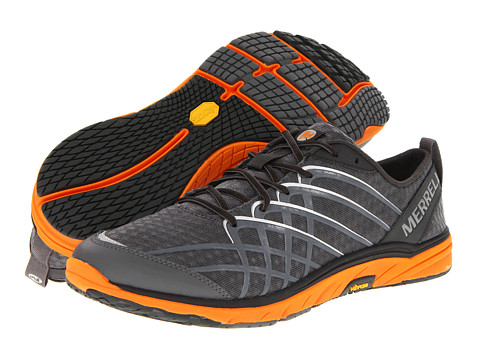 |
| Merrell Bare Access 2 |
 |
| Saucony Kinvara 4 |
The cushioning really was great, and I've generally liked the shoe a lot. However, as I ran more and more in them (both in terms of frequency and distance), I found my metatarsal pain was a frequent issue despite the cushioning, and I had started to get Achilles tendon pain, which I've never had. I saw my PT, who suggested a few things, which generally helped, but only until I ran again (even if I took a week off and really let the pain die down or away completely).
I realized the issue. Yes, you can toe strike in both the Bare Access 2 and Kinvara, but the effort it takes to do so was having an impact on my feet and Achilles. I'm a FFS runner, and most shoes in the minimal or natural category (save for the ultra-minimalist stuff like the Vapor Gloves and VFFs) really are best for mid-foot strikers. And most traditional shoes are very MFS-friendly (that is, you should be able to mid-foot strike just fine, despite their ramp-like construction).
 |
| Mizuno Cursoris |
My point is to take some time and really think about how your body wants to run. I can get preachy and tell you how it should run, but it's not about me and my beliefs or wants. It's about you and yours. You can buy a bunch of shoes to try them and see what's best, or you can think a bit up front, and let that define the must-have features. Just don't be afraid to adjust and learn as your body adjusts and learns. Learning is how your enlighten.your.body.
Tuesday, July 30, 2013
#CUYOP
What the heck is #CUYOP? Why is there a hash tag on it? CUYOP stands for Commute Under Your Own Power. I put a hash tag because I think we should be doing it and tweeting about it to get awareness and interest up.

I've started doing a mix of biking and running to work. It's between 9 and 12 miles, depending on the route I take, and can actually be faster than doing my drive and train mixed commute. Is definitely faster than a pure driving commute given traffic, and I save on gas and parking. I also get to take in gorgeous settings as I'm lucky enough to have a good chunk of the route along the Charles River. As much as I wanted to keep on running, I had to stop and take some photos this morning because it was just too amazing with the sun hitting the water and the way the skyline of the city came up (I was running on the Memorial Drive side, and these pics are from around the Hyatt, if you know the area).
 I do it to fuel a great trend of teaching my son about living a healthy, active life. That's not what my childhood was like, and I feel like much of my adult life has been working to undo those habits and the impact of that lifestyle. My son is 4, and regularly (and happily) makes really smart and healthy choices about food and being active. He knows about charity and wants to be involved when I get involved. He loves to run with me (we chase each other around the house, the basement, a soccer field, etc - laughing the whole time). We talk at dinner about my running, and he's very interested and curious. He also knows about a friend of mine who is really fast, so he's always asking if I was faster than him or if I saw him run by me (@steinesq, now you know why your ears are ringing so much).

I've started doing a mix of biking and running to work. It's between 9 and 12 miles, depending on the route I take, and can actually be faster than doing my drive and train mixed commute. Is definitely faster than a pure driving commute given traffic, and I save on gas and parking. I also get to take in gorgeous settings as I'm lucky enough to have a good chunk of the route along the Charles River. As much as I wanted to keep on running, I had to stop and take some photos this morning because it was just too amazing with the sun hitting the water and the way the skyline of the city came up (I was running on the Memorial Drive side, and these pics are from around the Hyatt, if you know the area).
I do it to get in a longer workout without having to wake up even earlier (I'm typically up no later than 4:30am).
 I do it to fuel a great trend of teaching my son about living a healthy, active life. That's not what my childhood was like, and I feel like much of my adult life has been working to undo those habits and the impact of that lifestyle. My son is 4, and regularly (and happily) makes really smart and healthy choices about food and being active. He knows about charity and wants to be involved when I get involved. He loves to run with me (we chase each other around the house, the basement, a soccer field, etc - laughing the whole time). We talk at dinner about my running, and he's very interested and curious. He also knows about a friend of mine who is really fast, so he's always asking if I was faster than him or if I saw him run by me (@steinesq, now you know why your ears are ringing so much).
I do it to get more time to relax, reset, think (or sometimes not think), and take the world in. For those of us chained to a desk so much of the day, it is crucial that we live out in the world if for only a few minutes a day. Every part of us will appreciate that more.
Can you CUYOP? Can you do it for even part of the commute? Biking, running, walking, Nordic skiing, roller blading - it doesn't matter, it all counts. You make a statement and investment in so many good things - your health, your fitness, your mind, the environment, your budget, how you role model to the next generation. There are countless ways this can help you enlighten.your.body.
Monday, July 29, 2013
When You Act Out, Who Do You Think You're Punishing?
 My wife, son and I were lucky to spend a great afternoon taking in a free concert in Boston recently amidst amazing weather, easy parking, and lots of PBS Kids characters (the poor guy in the Curious George suit was a good sport through all of my son's many friendly attacks of excitement to see him). For the Alison Krause concert that ended the weekend, people almost camped out to save a spot in Copley Square to take in the sounds. Some folks crept into the front to stand, blocking the view of those who spent so much time to get a good spot. As the show started, people were shouting for those up front to sit down. Most did, but not all.
There was one guy in particular who stood out, literally. He came in at the last minute, and wasn't right at the front. Instead, he was about 20 feet back, standing along in a sea of sitters. He was blocking the view for literally around 100 people. Literally. He just stood there, ignoring people as they asked him (nicely) to sit down. You might think maybe he didn't hear, but he did because he'd occasionally shout out, "Give it a rest! Why don't you stand up." Or have this look of disgust on his face. People got up and went to him to ask nicely for him to sit. He acted like they didn't exist. Some even gave up their seats in a better spot so he'd move and let so many people enjoy the show. He wasn't having it.
I had the pleasure of being one person away from him. I had a great view...of a sign and some scaffolding. I didn't care. What I cared about was this guy - I was unable to really focus on anything but this guy. His attitude befuddled me. He was smug. No better way to say it. Smug.
What I learned by watching him was that he actually wasn't enjoying the show at all. He seemed to be wishing for it to end. I don't know if he doesn't like the music (it's not my choice for music, but it's hard not to appreciate how amazing her voice is, or just feel peaceful listening to the sounds), or if he doesn't like people, or what. It was really a family-type event (lots of families and kids), and this 20-something guy being there alone with hundreds of daggers staring at him couldn't have given him a feeling of fitting in.
So why did he stay? Why did he stand? Why, when he was so miserable, did he keep doing this? Why rob little kids of enjoying the show when they had been patient and waiting for hours after their family got a little plot of the lawn?
Why? Because he had to prove to all those people - those horrible people who just wanted to enjoy their afternoon and were being nice and even offering him better spots - weren't going to beat him. They couldn't win - not on his watch! He'd show them! Right.
 And by, "Right," I mean, "Wrong. Completely wrong." When you are angry and smug like that, and act out in a childish way by being stubborn, rude and inconsiderate so as to punish all those people out there, you really are just punishing yourself. See, those people were still listening, smiling, and enjoying themselves. Sure, not as much as if he wasn't being this way, but they were happy. He was hunching his shoulders under the weight of the anger he were holding. He were cringing at your lack of enjoyment of the activity he was forcing himself to endure because he somehow thought that would ruin the day for others.
Why would any human being want to ruin the day for anyone else? What is gained? No, what he didn't understand was that the only punishment was being imposed on himself through the clearly horrible time he was having. Add to that the feeling of so many people that this guy is a bad person. A person who would never help another person. A person who has the capacity to be cruel and nasty when the world has far too much of that already. A person who wants to go into a sweet setting and try to make it sour.
I've had some personal experience in completely the opposite direction. When I ran my third race, I made a point of thanking every police officer I saw that held traffic for us runners; thanking every volunteer who gave out water, took photos or shared a smile; and cheered back at and pumped my fist for to every spectator who came out to watch or cheer us on. And it all made me feel energized and gave me a boost I really needed on a very hot and humid run.
 I do the same when biking or running when someone waits for me to go by or let's me pass. I don't want to leave anyone feeling pushed aside or inconvenienced by my enjoyment (or my desire to keep some pace going). I want them to think, "Hmm, that was unexpected and nice." I want them to get even a little spark of a good feeling for their small act of consideration and kindness. I was behind a woman this afternoon while biking home from work, and she was apparently uncomfortable feeling like she was holding people up. She kept looking back toward me, and then looking for places she could pull aside. She looked worried and pressured. I shouted up to her, "Don't worry - you're doing fine. Enjoy your ride." In that moment, I saw her shoulders drop a bit, like she had sighed a sigh of relief. She turned back and smiled at me, and rode with this happiness and calmness that had been missing since she realized I was behind her. At the next light, I passed her, and said, "Thanks so much. Have a great day." She had a big smile, and I'll bet she did enjoy her day. It took so little of me, but did so much to undo the tension she was feeling that she never had to feel.
The message is so simple. When you take your displeasure with a situation and try to make others pay for it, you only magnify the pain inflicted on yourself. When you try to be good to others despite how anyone has been to you, the world turns and you get to enjoy life as you deserve to. The smug, negative, hurtful people who try to infect others with their misery will just keep making things worse for themselves. Be someone who creates positivity and kindness. That is a key step to enlighten.your.body.
Review: Kinetic Compression Shirts
 The buildup
I wear tight clothes. Like really tight clothes. Clothes so tight, they squeeze me.
I don't wear them all the time. No, no. I wear these clothes most of the time that I'm working out. They're compression clothes (mainly spandex garments made in anatomically-inspired shapes with varying patterns and sections to target specific muscles for compression during exercise), and they have been shown to increase blood flow, aid performance and speed recovery by strategically squeezing (ever so slightly) key muscles used in sports/fitness/workouts like quads, calves, biceps, triceps, forearms, the core muscles, etc. From my own intensely scientific research, the stuff works. The only downside (aside from leaving nothing to the imagination if you don't wear something else on top of them) is the generally high price of compression clothing, or at least good compression clothing.
 Thank goodness for The Clymb. I have gotten some really high quality compression clothes at amazing discounts. My favorite brands are Skins, 2XU, Zoot and CW-X (in that order). I recently had a chance to pick up some shirts from Kinetik Sportswear, a brand I was less familiar with, but that had some intelligent design in their products that I thought would be worth trying. The deal was about 80% off, and these weren't 2 year old models, but products in their current line up. I went for it.
What it is & how it works
I got a long and short sleeve shirt as I could use another of each in my compression arsenal. Kinetik has an interesting design where the abs, forearms and muscles around the spine are set off in one fabric, and the shoulders, obliques and pecs are in another. There's also venting in the arms, as some Skins shirts have. There's also a rubbery/silicon lining to the bottom of the shirt to help keep it from riding up.
My impressions
 I really liked the look of these shirts, though my wife made fun of me in them as it sort of accentuates the boob-region. Sorry, I'm a child, I guess. I found the short sleeve shirt to fit nicely overall, and provide good compression where it needed to. I was comfortable in both shirts, and really appreciated the pit venting.
My depressions
You'll notice the impressions section is short. That's where I say the good stuff. You'll also know from my other reviews that I tend to be very positive on things I review. I'm not negative on Kinetik's shirts per se, but I do find more lacking than not.
First, the shirts run a touch bigger (or perhaps are slightly less compressive) than I've found with other brands. I have really found most compression clothing to be consistently sized across brands, with this being the first time I've had a feeling that the shirts could be tighter. As a result, I found that the collar really didn't lay flat (see the two pics of me wearing the short sleeve shirt while biking and you'll see how it stands up), and ended up bunching. It wasn't too uncomfortable when riding my road bike, but I noticed it when doing gym cardio (elliptical, mostly) and found it annoying. It's not the end of the world, but it's not something I generally experience in compression gear since they tend to hug your body.
And that leads to my second issue, and this is weird. You'll notice above I said I found the short sleeve shirt to fit nicely overall. The two shirts are the same, save for the sleeves, but I really found a difference in the level of compression. Neither is strong, but the core area on the long sleeve is noticeably less compressive / fits me noticeably looser than that of the short sleeve. That sort of defeats the purpose of the shirt for a major muscle area (and who hasn't heard about the importance of the core lately, right?). The rest of the shirt seems ok, especially the arms, but the abdomen and into the chest could stand to be something like 10% tighter on the long sleeve (and maybe 1-2% tighter on the short sleeve).
 The inconsistency across the shirts is concerning from a quality standpoint, or, more accurately, a quality control standpoint. I wonder if the same underlying driver is behind the neck collar issue I experienced. I also found the seems between the white and black areas to be a bit too pronounced. I'm not sure they're any more pronounced than on other brands, but they're in areas you're more likely to notice them, so I feel like the bar is higher. Also, because the shirts fit looser than I'm used to, the seems don't get squeezed to sit flat and tight like they would on a 2XU or Skins shirt. I have a Zoot shirt that fits looser, and it suffers from all of these issues.
So why am I tougher on the Kinetik shirts when I don't go off on the Zoot? Well, the Zoot shirt retails for about half of what the Kinetik goes for, and is at the bottom of their line (same reason I'm not really a fan of the bottom-of-the-line A100 series from Skins - you can tell how they went cheaper in the design and materials). The long sleeve Kinetik retails for $119 and the short sleeve for $89, which puts them on the high end price-wise. The only long sleeve I own that retails for more is a 2XU Elite shirt, and I have to say, it's clearly a much higher quality product from design to execution. Skins A200 and Sport lines are both much better performing shirts, and cost the same or slightly less.
 You could say I just need to size down, but I don't think that's possible for me. A small would be too short, and the arms would be too tight. The arms are perfectly sized for me with the mediums I bought, and I think going smaller would actually cut off blood flow. I also think the collar issue would be worse (or at least different) as the shirt would be pulled too much in the chest and shoulders. No, I think the sizing is fine, but the shirt isn't.
To buy or not to buy
So I think this part is pretty clear. I do like the short sleeve enough to want to wear it when I ride my rode bike. I could see myself wearing the long sleeve occasionally, but not when I know I'm going to be pushing myself. Had I paid retail, I'd either be trying to return both shirts, or pissed that I can't return both shirts. As much as I wanted to like these, and want to support an American company that is trying to make it in a very technical and competitive space, I just can't recommend this stuff...yet. I will definitely keep an eye on Kinetik Sportswear to see if they come into their own soon. Until then, I'd stick to Skins or 2XU, personally. You can't go wrong with either.
Saturday, July 13, 2013
Q: I'm running a lot, but not getting major results or being very structured. Is that ok?
Q: I've been running quite a bit, and have kept it up for a good while now. But I don't feel like I'm doing it in a structured way, and I'm not being as committed otherwise, so I'm not seeing the results in my body that I want to. I'm not doing well enough, am I?
A: This is a tough but common situation. The issue stems from having a long term goal and then universally judging yourself based on missing some sub-goals and throwing the long-term goals away. This exposes a really crucial aspect of proper goal setting, tracking, expectations and the spiral of negative generalizations.
When we set an overall goal, like completing five 5K races or losing 10 pounds and keeping it off, we must set sub-goals so that we can both track our progress and recognized incremental wins. It's also OK to miss some of these incremental steps as missing any particular one doesn't mean the overall goal is in question. This is the expectation you need to manage, and the place where a sub-goal being missed should not be allowed to turn into universal failure (or feelings of it).
Let's look at the five 5K goal. This was my goal for year two of my fitness journey (from July 1, 2012 to June 30th, 2013). Each race can be seen as a sub-goal. I didn't quite make it, but I did have wins along the way, and did come close plus picked up a good alternate challenge along the way. I did one 5K, a 3.5 miler (just over 5K, so that counts), a 10K (that counts as two, right?), and a three day/three mountain charity hike (my bonus challenge that was far more than 5K, but not technically a race - though I did run down some of the way on two mountains).
Am I sitting here feeling like a failure because I didn't get that final 5K race (if you could the 10K as two)? Definitely not. Instead, I basked in the glow of each race and my performance against goals I set for that particular race. I could have done another 5K, actually, but didn't have access to one that fit with my work and home schedules. Still, I should be riding the high of success on those sub-goals rather than throwing it all away because of the failure of one of the sub-goals.
Another great example is the person on a diet (which I'm not a fan of - let's eat healthily all the time rather than weirdly and extremely for a short period only go back to uneducated eating and re-gaining when we're done). The person 'is doing great' all day, but then goes out with friends to a bar, has a couple of beers and some nachos, and then goes home feeling terrible about how they just threw it all away and cracks open a pint of ice cream and whipped cream. They then order a pizza, and house the whole thing because it's all ruined.
The reality is that the beer and nachos weren't great, but certainly didn't throw away all the progress they had made on their diet thus far. Because they felt like they had totally - not partially, but totally - failed, they threw all progress out and went overboard.
What about looking at the success thus far and taking pride in that. And what about the restraint they showed at the bar by only having a couple of beers and some nachos rather than four or five beers and a whole order of nachos? They exercised some restraint.
Ultimately, this is what we're talking about - don't throw the whole goal away because some aspects of it might be off. Don't allow yourself to go down a path of negativity or depression because you fail to see the good or allow that positivity to resonate, reverberate, and drive you forward overall.
My specific advice to my friend with the question was to stop arguing about the failure in his running and overall progress. Stop and let the positive of the run soak in. He's running, and has been consistently for a while (and he's doing good distances - we're not talking little five minute jogs here, but 30-60 minute runs). He hasn't quit. These are all massively better than what most people can say, and certainly better than he could say just a few months ago (he's been at it consistently since May).
So he wants to look better and feel better than he does at the moment. I'm sure he looks and feels better than if he wasn't running. There are surely other ways he can spark better results, but it's important not to look at the seven other things to be mindful of and get so overwhelmed that he quits. By the same token, you can get extreme and do it all right away, and surely get those desired results fast. But what are the chances the behaviors would endure? Would he be likely to burn out due to the major changes needed all at once? Would he burn out from doing too much too fast? What good are results if they can't be maintained? Not very, I'd say.
Take the win of running, be proud, uplift yourself. Then choose one more thing to work on at a time in succession until your life is going the way you want with the results you crave in a consistent, manageable fashion. This is how you enlighten.your.body.
Subscribe to:
Posts (Atom)